Understanding the asbestos abatement process is essential for any property owner facing renovation or demolition.
Whether you've discovered asbestos during a home inspection or are planning commercial construction, knowing what to expect helps you make informed decisions, avoid costly mistakes, and protect everyone involved. This guide breaks down every stage of professional asbestos abatement—from initial testing through final clearance—so you can approach your project with confidence.
What is asbestos abatement?
Asbestos abatement is the professional process of identifying, containing, removing, and disposing of asbestos-containing materials (ACM) from buildings and structures. Unlike simple demolition or renovation, asbestos abatement requires specialized equipment, certified technicians, and strict regulatory compliance to prevent hazardous fiber release into the air.
The term "abatement" encompasses several activities:
- •Encapsulation: Sealing asbestos materials with specialized coatings to prevent fiber release (used when removal isn't practical)
- •Enclosure: Building permanent barriers around asbestos materials to contain fibers
- •Removal: Complete extraction and disposal of asbestos-containing materials (the most common and permanent solution)
Most residential and commercial projects require complete removal because encapsulation and enclosure only delay the problem. Future renovations or structural changes will eventually require removal anyway, making it more cost-effective to address asbestos permanently when discovered.
When is asbestos abatement necessary?
Professional asbestos abatement becomes necessary when:
- •You're planning renovation or demolition in a building constructed before 1990
- •Laboratory testing confirms the presence of asbestos-containing materials
- •Asbestos materials are damaged, deteriorating, or will be disturbed by construction
- •You're selling a property and buyers require documentation of asbestos removal
- •Local building codes require abatement before issuing permits (common in Calgary, Edmonton, and other Alberta cities)
- •Emergency situations like fire, flood, or structural damage have exposed asbestos materials
In Calgary specifically, the City's Building Services department requires an Asbestos Management Form for any project involving more than 1 square meter of friable asbestos or 10 square meters of non-friable asbestos. This regulatory trigger means most renovation projects eventually require professional abatement services.
Why asbestos abatement matters for health and safety
Asbestos exposure causes serious, often fatal diseases—making professional abatement a critical health protection measure, not just a regulatory checkbox. When asbestos fibers become airborne and are inhaled, they lodge in lung tissue and cannot be expelled by the body's natural defenses.
Health risks of asbestos exposure
The primary diseases linked to asbestos exposure include:
- •Asbestosis: Progressive scarring of lung tissue causing shortness of breath, chronic cough, and reduced lung capacity. No cure exists.
- •Mesothelioma: Aggressive cancer affecting the lining of lungs, abdomen, or heart. Extremely rare outside asbestos exposure.
- •Lung cancer: Asbestos exposure significantly increases lung cancer risk, especially combined with smoking.
- •Pleural diseases: Thickening and calcification of lung lining causing breathing difficulties and chest pain.
These diseases develop slowly—often 10 to 40 years after initial exposure. This latency period means that brief, seemingly minor exposure during DIY demolition can cause disease decades later. There's no safe level of asbestos exposure, and even single fiber inhalation can initiate disease processes.
Who is at risk?
Anyone present during unprofessional asbestos disturbance faces exposure risk:
- •Homeowners and family members: DIY renovation attempts expose everyone in the home, including children who are especially vulnerable
- •Contractors and workers: Unlicensed renovators and their crews face occupational exposure without proper respiratory protection
- •Future occupants: Incomplete removal or improper cleanup leaves residual contamination that continues releasing fibers
- •Neighbors: Airborne fibers can migrate to adjacent properties through ventilation systems or open windows
Professional asbestos abatement using certified containment, HEPA filtration, and clearance testing eliminates these risks. The investment in proper removal protects not just your immediate health, but long-term property value and legal liability.
Professional vs DIY asbestos abatement: Why certification matters
Some homeowners consider tackling asbestos removal themselves to save money. While Alberta regulations technically permit property owners to remove small amounts of asbestos from their own homes, the reality is that DIY asbestos work is dangerous, illegal in many contexts, and ultimately more expensive when considering health risks and compliance failures.
Legal and regulatory considerations
Professional asbestos abatement is required by law in these situations:
- •Commercial properties: Alberta OH&S Code Part 4 mandates certified abatement for all workplace asbestos removal
- •Rental properties: Landlords must hire licensed contractors to protect tenant health
- •Permitted projects: City of Calgary and most municipalities require certified contractors for permitted abatement work
- •Disposal: Only licensed contractors can transport and dispose of asbestos at approved facilities like Shepard Landfill
Even when DIY removal is technically legal, it violates most homeowner insurance policies. Claims for asbestos contamination, exposure lawsuits, or property damage during removal will likely be denied if professional contractors weren't used.
Why professional abatement is safer
Certified asbestos abatement contractors provide safety measures impossible to replicate in DIY projects:
- •Engineered containment systems: Negative-air enclosures with HEPA filtration prevent fiber migration beyond work zones
- •Proper respiratory protection: Full-face respirators with P100 filters or supplied-air systems (not hardware store dust masks)
- •Wet removal methods: Specialized equipment and wetting agents suppress fiber release during material removal
- •Decontamination procedures: Three-stage wash stations prevent workers from carrying fibers outside containment
- •Air monitoring: Real-time fiber measurement ensures containment effectiveness throughout the project
- •Third-party clearance testing: Independent hygienists verify safe fiber levels before re-occupancy
Professional contractors also carry liability insurance protecting you from exposure claims, property damage, and compliance penalties. When you hire Makki Abatement in Calgary, our $5 million insurance coverage transfers financial risk away from your personal assets.
Cost comparison: DIY vs professional removal
While DIY may seem cheaper initially, the true cost calculation includes:
- •Equipment rental: Negative-air machines, HEPA vacuums, and decontamination supplies ($500-$1,500)
- •Protective gear: Tyvek suits, respirators, gloves, goggles for all workers ($200-$500)
- •Disposal fees: Shepard Landfill charges by weight, and DIY haulers often face higher rates ($150-$400)
- •Testing costs: Pre-removal sampling and post-removal clearance testing ($500-$1,500)
- •Lost time: Learning procedures, permit filing, and slower removal pace (often 3-5x longer than professionals)
Most importantly, failed clearance testing requires complete re-cleaning or professional intervention—often costing more than hiring professionals initially. Professional asbestos removal typically costs $1,500-$10,000 for residential projects, but includes permitting, guaranteed clearance, and legal compliance that DIY cannot match.
Step-by-step asbestos abatement process
Professional asbestos abatement follows a systematic process designed to eliminate exposure risk while meeting regulatory requirements. Here's what happens during a typical project:
Step 1: Initial inspection and asbestos testing
Every professional abatement project begins with comprehensive testing to identify asbestos-containing materials and determine removal scope.
What happens during inspection:
- •Certified inspectors visit your property to examine suspect materials including ceilings, floor tiles, insulation, drywall compound, pipe wrap, and siding
- •Bulk samples are collected from each suspect material using specialized tools that minimize fiber release
- •Samples are sent to accredited laboratories for analysis using polarized light microscopy (PLM) or transmission electron microscopy (TEM)
- •Laboratory reports identify material composition, asbestos type (chrysotile, amosite, crocidolite), and concentration percentages
- •Inspectors prepare detailed reports with floor plans showing asbestos locations, photographs, and removal recommendations
In Calgary, laboratory results typically return within 24-48 hours for rush analysis or 3-5 business days for standard turnaround. These reports form the foundation for permit applications and abatement planning. Companies like Makki Abatement offer free inspections when removal services are used, making testing accessible for all property owners.
Step 2: Permit filing and project planning
Once asbestos is confirmed, certified contractors prepare regulatory documentation and design containment systems.
Permit requirements in Calgary:
- •City of Calgary Asbestos Management Form filed through the ePermit portal
- •Laboratory reports and material identification attached to application
- •Detailed scope of work describing containment methods, removal procedures, and disposal plans
- •Alberta OH&S notifications for Type 2 and Type 3 (high-risk) projects
- •Waste transport manifests and Shepard Landfill disposal booking confirmations
Professional contractors handle all paperwork, saving you from navigating complex municipal and provincial requirements. Permit approval typically takes 3-5 business days in Calgary, though rush processing is available for emergency situations.
Step 3: Containment setup and preparation
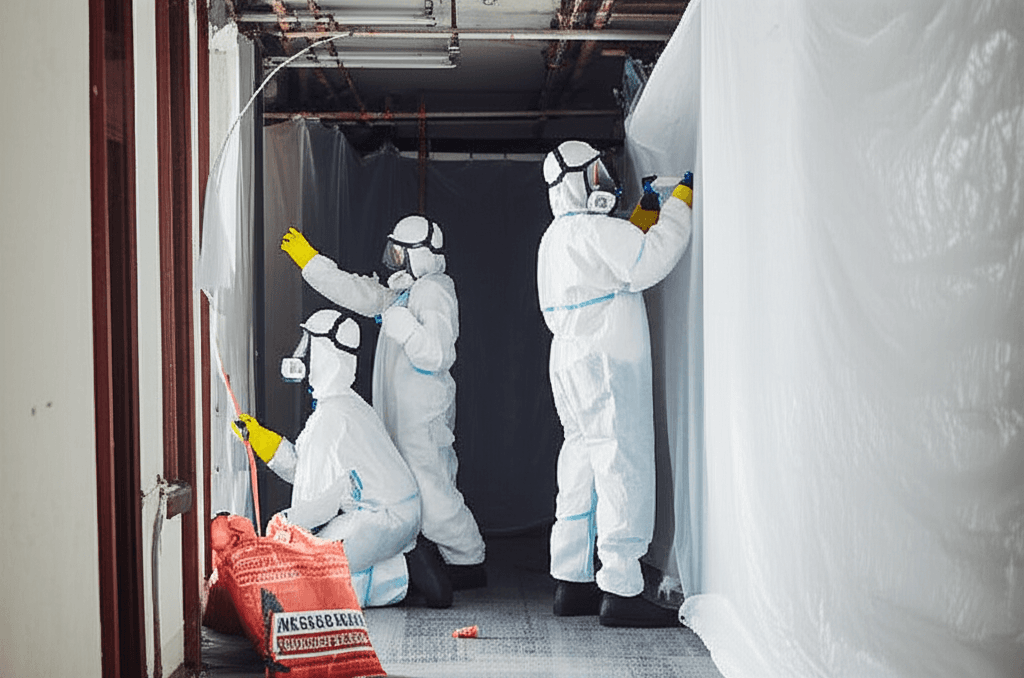
Before any material is disturbed, certified crews build engineered containment zones to isolate asbestos work areas from occupied spaces.
Containment components include:
- •Polyethylene barriers: 6-mil plastic sheeting seals floors, walls, and ceilings creating airtight work zones
- •Negative-air machines: HEPA-filtered fans create negative pressure, pulling air into containment and preventing fiber escape
- •Decontamination chambers: Three-stage areas for workers to remove protective equipment and shower before exiting
- •HVAC isolation: Ventilation systems are sealed to prevent fiber migration through ductwork
- •Signage and access control: Warning signs and physical barriers prevent unauthorized entry
Alberta regulations define three containment types based on material friability and project scope:
- •Type 1: Low-risk work with minimal fiber release potential (small amounts of non-friable material)
- •Type 2: Moderate-risk work requiring partial containment and respiratory protection
- •Type 3: High-risk work demanding full containment, negative air, and decontamination chambers
Most residential projects require Type 2 or Type 3 containment. Setup typically takes 2-4 hours depending on project size and building configuration.
Step 4: Material removal and waste handling
With containment established, certified technicians begin careful removal using wet methods and specialized equipment.
Removal procedures include:
- •Wet methods: Materials are saturated with amended water or surfactants to suppress dust and fiber release
- •Hand tools: Manual removal using scrapers, pry bars, and cutting tools designed for asbestos work
- •HEPA vacuuming: High-efficiency vacuums capture fibers during removal and cleanup
- •Double-bagging: All waste is placed in 6-mil polyethylene bags, sealed, labeled, and placed in second bags
- •Air monitoring: Real-time fiber measurements verify containment effectiveness throughout removal
Workers wear full protective equipment including respirators with P100 filters or supplied-air systems, disposable Tyvek suits, gloves, and boot covers. All equipment is removed before exiting the decontamination chamber, preventing fiber transport outside containment.
Common materials removed in Calgary projects:
- •Vermiculite attic insulation (common in homes built 1930s-1980s)
- •9×9 and 12×12 vinyl asbestos floor tiles
- •Popcorn ceiling texture and acoustic ceiling tiles
- •Drywall joint compound and textured plaster
- •Pipe and boiler insulation in basements and mechanical rooms
- •Cement board siding and roofing materials
Step 5: Proper disposal and waste transport
Asbestos waste disposal is strictly regulated to protect landfill workers and prevent environmental contamination.
Calgary disposal requirements:
- •All asbestos waste must be transported to the Shepard Landfill asbestos disposal cell (the only approved facility in Calgary)
- •Advance booking required by calling 403-268-2282
- •Transport follows Transport Canada TDG (Transportation of Dangerous Goods) regulations
- •Vehicles must be properly placarded and drivers trained in dangerous goods handling
- •Waste manifests track material from site to final disposal
- •Certified disposal receipts document proper handling for future property transactions
Professional contractors maintain relationships with disposal facilities and handle all scheduling, transport, and documentation. These disposal records become part of your property's permanent documentation, proving compliant asbestos management to future buyers, insurance companies, and regulatory authorities.
Step 6: Air quality testing and clearance
After all material is removed and the work area is thoroughly cleaned, independent third-party hygienists conduct clearance testing to verify safe fiber levels.
Clearance testing procedures:
- •Visual inspection: Hygienists examine all surfaces for visible debris, dust, or residual materials
- •HEPA vacuuming: All surfaces are vacuumed using HEPA-filtered equipment
- •Wet wiping: Surfaces are wiped with damp cloths to capture any remaining fibers
- •Aggressive air sampling: Hygienists use fans and leaf blowers to agitate remaining dust while collecting air samples
- •Laboratory analysis: Air samples are analyzed using phase-contrast microscopy (PCM) or transmission electron microscopy (TEM)
- •Clearance determination: Fiber levels must be below 0.01 fibers per cubic centimeter (f/cc) to meet Alberta occupancy standards
If clearance testing fails, the work area must be re-cleaned and re-tested—at the contractor's expense if the failure resulted from inadequate cleaning. Professional contractors like Makki Abatement have zero failed clearance tests in recent years because proper procedures are followed from the start.
Final documentation includes:
- •Written clearance letters from independent hygienists
- •Laboratory air test results
- •Photographic documentation of completed work
- •Waste disposal receipts and manifests
- •Permit closure confirmation from City of Calgary Building Services
This documentation package protects you legally, satisfies insurance requirements, and provides valuable records for future property transactions. Keep these documents permanently with your property files.
Step 7: Post-abatement reconstruction
Once clearance is confirmed, containment is dismantled and your property is ready for reconstruction. Many professional abatement companies offer integrated services to streamline the transition:
- •Selective demolition: Removal of non-asbestos building components after clearance
- •Site cleanup: Final cleaning and preparation for renovation trades
- •Coordination with contractors: Communication with general contractors, electricians, plumbers, and other trades to maintain project schedules
At Makki Abatement, our selective demolition team can begin work immediately after clearance, eliminating delays and simplifying contractor coordination for Calgary property owners.
Trust Calgary's certified asbestos abatement specialists
Frequently asked questions about asbestos abatement
How long does the asbestos abatement process take?
Complete asbestos abatement timelines vary based on project size and material type, but typical residential projects follow this schedule:
- •Initial inspection and testing: 1 day for sampling, 1-3 days for laboratory results
- •Permit filing: 3-5 business days for City of Calgary approval
- •Containment setup: 2-4 hours for most residential projects
- •Material removal: 1-3 days depending on material extent and location
- •Clearance testing: 1 day for sampling, 1-2 days for laboratory analysis
- •Total timeline: 7-14 days from initial inspection to final clearance
Small projects like single-room floor tile removal can be completed in 2-3 days total. Large projects like whole-home vermiculite insulation removal may require 2-3 weeks. Emergency projects can be fast-tracked with rush permitting and testing, often completing within 3-5 days.
What safety measures protect my family during abatement?
Professional asbestos abatement uses multiple safety layers to prevent exposure:
- •Physical containment: Airtight barriers isolate work areas from occupied spaces
- •Negative air pressure: HEPA-filtered fans pull air into containment, preventing fiber migration
- •Occupant relocation: Most contractors recommend occupants vacate during active removal (typically 1-3 days)
- •Adjacent space protection: HVAC systems sealed, doorways protected, and neighboring areas monitored
- •Real-time monitoring: Air sampling during removal verifies containment effectiveness
- •Third-party verification: Independent clearance testing confirms zero contamination before re-occupancy
Many Calgary families choose to stay with relatives or in hotels during active removal, though properly contained projects pose no risk to adjacent rooms. Pets should also be relocated during abatement to prevent stress and accidental containment breaches.
Can I stay in my home during asbestos abatement?
Occupancy during abatement depends on project scope and containment location:
- •Small, isolated projects: You can typically remain in your home if work is contained to a basement, attic, or single room with no shared ventilation
- •Multi-room or HVAC-connected projects: Relocation is recommended for the 1-3 days of active removal
- •Whole-home projects: Complete relocation required until clearance testing confirms safe re-occupancy
Professional contractors will recommend occupancy plans based on your specific project. The cost of temporary housing is minimal compared to the risk of exposure—especially for children, elderly family members, or those with respiratory conditions.
How much does professional asbestos abatement cost?
Calgary asbestos abatement costs typically range from $1,500 to $10,000+ for residential projects:
- •Small projects: Single-room floor tile removal ($1,500-$3,000)
- •Medium projects: Popcorn ceiling removal for 2-3 rooms ($2,500-$5,000)
- •Large projects: Whole-home vermiculite insulation removal ($6,000-$12,000+)
- •Complex projects: Multi-zone commercial or industrial removal (quoted individually)
Pricing factors include:
- •Material type (friable materials require more extensive containment)
- •Square footage and accessibility
- •Containment complexity (Type 1 vs Type 3)
- •Disposal volume and transport distance
- •Clearance testing requirements
- •Permit and regulatory compliance costs
Most professional contractors offer free on-site estimates with detailed, itemized pricing. Makki Abatement provides transparent quotes with no hidden fees—what we quote is what you pay. Learn more about our Calgary asbestos removal services and pricing.
What certifications should my asbestos abatement contractor have?
In Alberta, legitimate asbestos abatement contractors must have:
- •CSA Z94.4 certification: Canadian standard for asbestos abatement training (all supervisors and technicians)
- •Alberta OH&S compliance: Current documentation showing Part 4 hazardous materials compliance
- •General liability insurance: Minimum $2 million, ideally $5 million or higher
- •WCB coverage: Workers' Compensation Board coverage for all employees
- •Transport Canada TDG: Transportation of Dangerous Goods certification for waste hauling
- •Medical surveillance: Respiratory monitoring programs for all workers
Always request proof of certification and insurance before hiring any contractor. Legitimate companies will provide this documentation immediately. Be wary of contractors who:
- •Cannot provide certification proof
- •Offer significantly lower pricing than competitors (likely cutting safety corners)
- •Suggest you don't need permits or testing
- •Recommend DIY removal to "save money"
- •Cannot provide references from recent Calgary projects
Conclusion: Protecting health through proper abatement
The asbestos abatement process may seem complex, but every step exists to protect your health, comply with regulations, and preserve property value. By understanding what professional abatement involves—from initial testing through final clearance—you can make informed decisions and avoid the costly mistakes that come with DIY attempts or unlicensed contractors.
Whether you're planning a Calgary home renovation, managing a commercial property, or responding to an emergency asbestos discovery, partnering with certified professionals ensures the job is done safely, legally, and permanently. The investment in proper abatement protects what matters most: your health, your family's wellbeing, and your property's future value.
Ready to start your asbestos abatement project? Contact Makki Abatement for a free Calgary inspection and transparent pricing. Our certified technicians are available 24/7 for emergency response and routine projects throughout Calgary and surrounding communities.
Additional resources:
Ready to start your asbestos removal project?
Request a free inspection or call 403-392-2803 to coordinate with Makki Abatement's certified team.