24/7 response across the Calgary Metropolitan Region
Asbestos Decontamination & Post-Disturbance Cleaning in Calgary
When asbestos-containing material is disturbed without warning, the problem is no longer confined to the material itself. Fibre settles on surfaces, works into contents, and moves through ductwork into rooms nobody was working in. Decontamination cleaning is the work of getting that space and everything in it back to a verified clearance standard.
Makki Abatement responds around the clock across Calgary, Airdrie, Cochrane, Okotoks, Chestermere, and Canmore.
Report a Fibre Release Episode
What decontamination cleaning covers
This is a cleaning service, not a removal service. The distinction matters both practically and on your invoice. Decontamination cleaning addresses the consequences of a disturbance: the settled fibre, the contaminated contents, and the ventilation system that distributed it. It restores a space that has already been contaminated.
The source material is a separate question. If the material that was disturbed is still in place and still friable, it needs a scoped removal plan of its own — and cleaning a space while the source is still shedding achieves very little. Where both apply, we sequence them so the removal happens first and the final clean lands at the end, once.
Still have the source material in place? Removal of asbestos-containing building materials is handled by our Calgary asbestos abatement team, who will scope the containment and removal before the final clean is scheduled.
How fibre release episodes usually happen
Calgary's pre-1990 building stock — the inner-city bungalows of Bowness and Renfrew, the walk-up apartment blocks around the Beltline, and the industrial buildings through Foothills and Manchester — is full of material that behaves perfectly well until something hits it. Almost every call we take starts one of these five ways.
Renovation cut into untested material
A contractor opens a wall, ceiling, or floor in a pre-1990 Calgary building and only afterwards learns the material was suspect. Settled dust spreads well past the work area on boots and air currents.
Mechanical or plumbing failure
A pipe burst or a failed boiler jacket in an older mechanical room disturbs pipe-wrap insulation. Water carries debris across the floor slab and into adjacent tenant space.
Vandalism, break-in, or vacancy damage
Ceiling tiles, ducting, or insulation are pulled apart in an unoccupied building. Nobody is aware of the disturbance until the property is reopened weeks later.
Fire, flood, or storm damage
Emergency crews and drying equipment move air aggressively through a damaged structure, redistributing fibre from disturbed building materials throughout the envelope.
Containment breach on an active project
A poly barrier fails or negative pressure is lost during an unrelated project. Adjacent areas outside the work zone require cleaning before work can resume.
What to do in the first hour
What happens before we arrive has a direct effect on how large the eventual clean becomes. Four things matter more than anything else:
- 1Stop work and leave the area. Every additional minute of activity grinds settled debris finer and pushes it further.
- 2Shut down the HVAC serving that zone. A running furnace or rooftop unit will turn a one-room problem into a whole-building problem faster than anything else on site.
- 3Do not sweep, dust, or shop-vac. A standard vacuum passes fibre straight through the filter and discharges it back into the room at speed. This single mistake accounts for a large share of the oversized cleans we are called to.
- 4Keep people and pets out, and keep the clothing. Anyone who was in the space should bag what they were wearing rather than wearing it home or through the rest of the building.
Alberta's Occupational Health and Safety Code, Part 4, obliges employers to control worker exposure to asbestos and to keep exposure records where that exposure has occurred. If a disturbance happened on a worksite, that obligation is already live — documenting the response from the first hour is part of meeting it.
Our decontamination sequence
The order is not negotiable. Cleaning before the space is isolated simply relocates the problem.
1. Isolate and stabilise
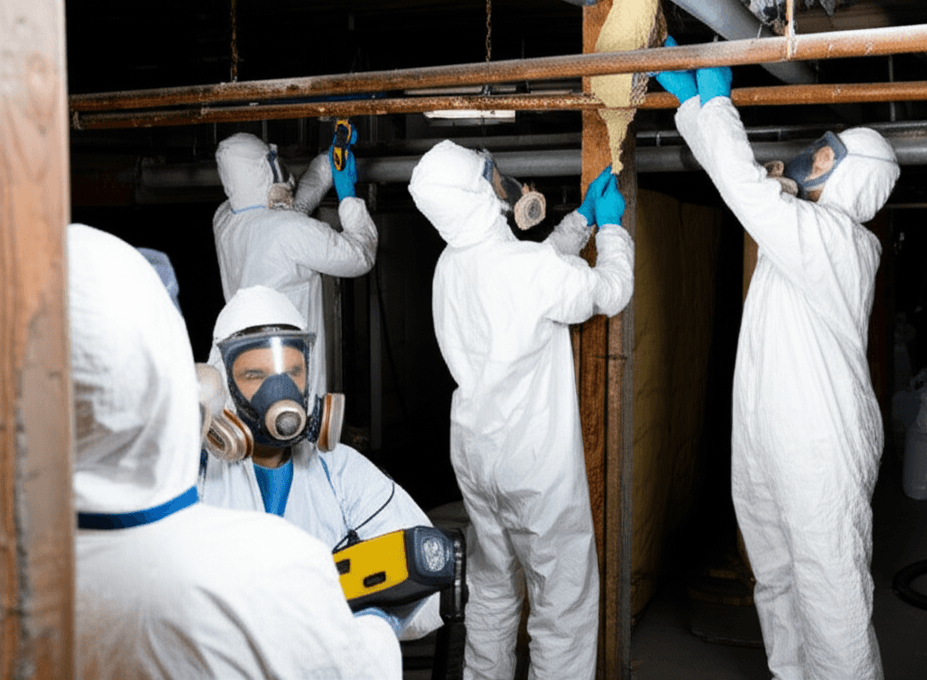
We stop air movement first. HVAC serving the affected zone is shut down and sealed at supply and return, doorways are closed off, and negative pressure is established so the contaminated area stops feeding fibre into the rest of the building. Nothing leaves the space until this is in place.
2. Define the boundary
Settled dust travels further than most people expect. We walk the adjacent rooms, corridors, and mechanical spaces to determine where cleaning actually needs to stop, rather than assuming the disturbance stayed where it started. Sampling to confirm the boundary is coordinated through our testing team.
3. Gross debris and settled dust
Visible debris is bagged as regulated waste. Surfaces are then worked top-down — ceilings, walls, ledges, then floors — using HEPA vacuums and wet wiping. Dry sweeping and compressed air are never used, since both re-aerosolise the fibre we are trying to capture.
4. Contents cleaning
Furniture, equipment, stock, and personal effects are cleaned in place or moved to a staged decontamination area. Items are HEPA-vacuumed and wet-wiped before they cross the containment boundary, so the clean space stays clean.
5. HVAC and cavity cleaning
Where the ventilation system ran during or after the disturbance, ductwork, coils, and returns are cleaned so the system does not recontaminate the space on the next call for heat. Wall and floor cavities that took in debris are addressed at the same time.
6. Final clean and clearance
The area receives a clearance-standard final clean, then sits under negative pressure until air clearance is performed. Containment comes down only after the result is in. You receive the clearance documentation with the project file.
How we handle contents
Contents are usually where the cost of a decontamination project is decided, and where owners most want a straight answer. Our rule is simple: if an item cannot be cleaned to a standard we would verify, we tell you to replace it rather than charging you to clean it twice.
| Item type | Typical approach | Notes |
|---|---|---|
| Hard, non-porous items | Clean and return | Metal, glass, sealed plastics, finished wood, appliances, and tooling. HEPA-vacuumed and wet-wiped, then passed out through the decontamination stage. |
| Electronics | Clean with care | Cabinets and exteriors are cleaned conventionally; intake vents and internal fans need controlled attention, since running the unit later can discharge settled fibre. |
| Textiles and upholstery | Assess individually | Some items clean successfully. Deep-pile and open-weave materials that trap fibre often cost more to clean than to replace, and we will say so before you spend money on them. |
| Loose paper and documents | Assess individually | Bound and boxed records usually survive with exterior cleaning. Loose, exposed paper is difficult to decontaminate reliably and is often better scanned and discarded. |
| Open insulation and damaged porous materials | Remove as waste | Materials that cannot be cleaned to a verifiable standard are bagged and disposed of as regulated waste rather than returned to the space. |
Ventilation systems and why they get missed
The most common reason a space fails clearance after somebody else has cleaned it is that the ductwork was never touched. A furnace that ran for even an hour during a disturbance has pulled fibre into the return, past the filter, across the coil, and out to every supply register on the system. Cleaning the room and leaving the ducts means the next call for heat puts the contamination straight back.
This is a particular risk in Calgary through the heating season, when systems cycle frequently and a disturbance in a basement mechanical room reaches the whole house within a day. It matters just as much in multi-tenant commercial buildings, where a shared rooftop unit can carry a single suite's problem into neighbouring leases and turn a contained incident into a liability conversation with other tenants.
We inspect the system before deciding scope, clean supply and return runs where contamination is confirmed, replace filtration, and leave the system sealed until clearance is achieved.
Finishing to a verified standard
A decontamination project is not finished when the space looks clean. It is finished when a clearance result confirms it is, with containment still standing so there is a way back if the result says otherwise. We hold negative pressure through clearance for exactly that reason.
Sampling and analysis are coordinated through our Calgary asbestos testing team, who handle the lab relationship and chain-of-custody paperwork. You receive the clearance result together with the cleaning scope, containment photographs, and waste documentation as a single project file — the package that restoration contractors, adjusters, and incoming tenants ask for.
Frequently asked questions
We cut into drywall before testing it. What happens now?
Stop work, leave the area, and shut down the furnace or rooftop unit serving that zone so the ventilation system stops distributing fibre. Do not sweep or vacuum with a household machine. Call us and we will isolate the room, assess how far settled dust has travelled, and scope the clean from there.
How is decontamination cleaning different from removing the material?
Removal deals with the source material itself. Decontamination cleaning deals with what the disturbance left behind — settled fibre on surfaces, contents, and inside ductwork. A space frequently needs both, and where the source material is still present we scope the removal separately.
Can furniture, electronics, and documents be saved?
Usually. Hard, non-porous items clean reliably through HEPA vacuuming and wet wiping. Porous items — upholstery, mattresses, open insulation, loose paper — are assessed case by case, and we will tell you plainly when replacement costs less than cleaning.
How long does a decontamination clean take?
A single room with limited settled dust is typically a one-day scope. A whole floor with HVAC involvement runs three to five days including clearance. Occupancy, containment size, and how long the space sat before we arrived are the variables that move that number most.
Do you provide documentation for insurance?
Yes. You receive a scope-of-work record, photographs of containment and staged cleaning, waste disposal documentation, and the clearance result. Restoration contractors and adjusters generally require all four before approving reconstruction.
Related services
Decontamination cleaning rarely stands alone. Depending on what the assessment finds, the project may also involve:
- Asbestos abatement — where the disturbed source material is still in place and needs a scoped removal before the space can be cleaned for the last time.
- Asbestos testing — to identify what was disturbed, map how far it travelled, and provide the clearance result at the end.
- Calgary service area — response times, coverage, and local permit context for projects inside the city.
24/7 fibre release response
Disturbed something you should not have?
Isolate the area, shut down the HVAC, and call us. We will scope the decontamination, clean the space and its contents, and finish to a verified clearance standard.
24/7 emergency response across Calgary and surrounding communities.