
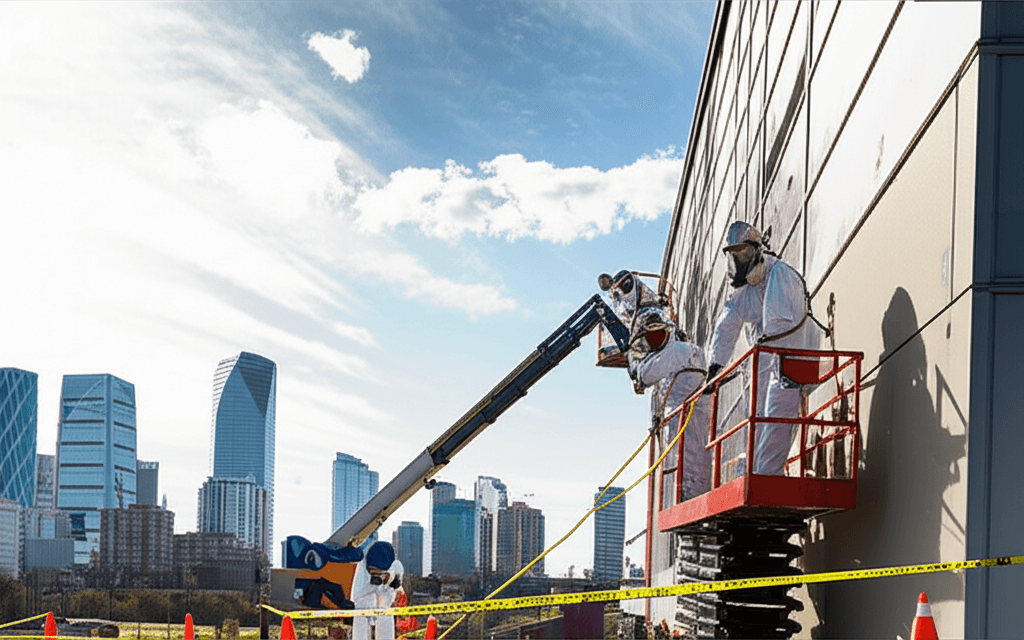
Pre-demolition and pre-renovation assessment
Hazmat Testing & Designated Substance Surveys in Calgary
Before a building comes apart, somebody has to establish what is in it. A designated substance survey covers the full regulated set — asbestos, lead, mercury, PCBs, silica, mould, and ozone-depleting substances — in one assessment, so the project can be priced and sequenced from a complete register rather than a series of assumptions.
Scope a Survey for Your Project
Why one assessment instead of several
The expensive failure on a demolition project is almost never the hazardous material itself. It is finding the second one halfway through. A crew is on site, a schedule is committed, and a substance nobody assessed turns up behind a wall — at which point the work stops, the scope is re-priced under time pressure, and the contingency that was supposed to cover it turns out to have been a guess.
A multi-substance survey exists to prevent that specific outcome. One mobilisation, one register, one report a general contractor can price against. On a Calgary building put up before 1990, the realistic expectation is not whether something will be found but how many of the seven substances below will appear together.
Full survey or single-substance test?
Both are legitimate. Which one is right depends on whether you are making a decision about one material or pricing a whole project. If you already know the specific material you need answered — one ceiling, one floor — a single-substance test is faster and cheaper, and over-scoping it wastes money.
| Full hazmat survey | Single-substance test | |
|---|---|---|
| What it covers | Every regulated substance present in the building, assessed together in one mobilisation | One substance, answering one specific question |
| Typical trigger | Full or partial demolition, major renovation, pre-purchase due diligence, tendering a project | A specific material about to be disturbed — a ceiling before a reno, a floor before replacement |
| Scope certainty | High. The register is intended to be complete, so a general contractor can price the work rather than carry a contingency | Limited to what was sampled. Anything outside that scope is unknown, not absent |
| Fieldwork | Half a day for a house; one to two days for a commercial floorplate | Typically one visit of an hour or two |
| Cost basis | Priced by building size, complexity, and number of substances in scope | Priced per sample plus a mobilisation charge |
| What the report supports | Permit applications, tender packages, contractor pricing, purchase negotiations, and the abatement sequence | A go / no-go decision on one specific piece of work |
| The risk of choosing wrong | Over-scoping a small job. If you only need to know about one ceiling, this is more assessment than the decision requires | Discovering a second substance mid-demolition, which stops the job and re-prices it under time pressure |
The short version: if a contractor is going to price work from the result, commission the survey. If you are answering one question about one material, book the single test and keep the money.
Substances covered
Scope is set from the building's age, construction type, and use. Not every substance applies to every property, and the assessment says so rather than billing for sampling that the building does not warrant.
Asbestos-containing materials
Typically found in: Drywall joint compound, vinyl tile and mastic, pipe and boiler insulation, textured ceilings, roofing, transite panels
The single most common finding in Calgary's pre-1990 stock, and usually the item that determines the project sequence.
Lead-based coatings
Typically found in: Painted trim, doors, windows, structural steel, exterior masonry coatings
Frequently missed because the paint looks sound. Disturbance during demolition is what releases it.
Mercury
Typically found in: Thermostats, switches, fluorescent tubes and HID lamps, some gauges and manometers
Small components, disproportionate disposal consequences. Usually a straightforward removal once identified.
Polychlorinated biphenyls (PCBs)
Typically found in: Pre-1980 light ballasts, transformers, capacitors, some caulking and sealants
Building caulking is the finding that surprises owners most, and it can drive disposal costs on envelope work.
Crystalline silica
Typically found in: Concrete, masonry, mortar, tile, engineered stone
Present by definition rather than by discovery. What the survey establishes is the exposure control the work will require.
Mould and microbial growth
Typically found in: Wall and ceiling cavities, sub-floor assemblies, mechanical rooms, anywhere with a moisture history
Identified and mapped during the survey. Where remediation is needed it is scoped separately.
Ozone-depleting substances
Typically found in: Refrigeration and air-conditioning equipment, chillers, some fire suppression systems
Regulated recovery is required before equipment can be decommissioned or scrapped.
Alberta requirements and Calgary permits
Alberta's Occupational Health and Safety Code, Part 4, requires an employer to identify hazardous substances at a work site and assess worker exposure before work begins. On a demolition or renovation project that obligation lands on the general contractor, and a survey is how it is discharged in practice.
The City of Calgary requires hazardous material assessment documentation before issuing demolition permits on older structures, and the surrounding municipalities — Airdrie, Cochrane, Okotoks, Chestermere, and Canmore — apply comparable requirements with local variations in how documentation is submitted. Reports are prepared to be accepted at submission rather than returned for clarification.
Waste routing is part of the same conversation. Regulated materials have specific receiving requirements, and the survey report identifies the disposal route for each finding so the contractor is not solving that problem with a loaded truck.
What the report contains
Substance register
Every material assessed, its location, its condition, and whether it is confirmed, presumed, or ruled out. Presumed findings are labelled as such rather than presented as results.
Marked floor plans
Sample locations plotted against the building, so a crew can find the material rather than interpret a written description on site.
Laboratory certificates
Analysis from accredited laboratories with full chain-of-custody documentation attached, not summarised.
Sequenced recommendations
Findings ordered by the work they trigger, so removal happens in a sequence that does not disturb one hazard while addressing another.
Frequently asked questions
What is a designated substance survey?
A single assessment that looks for every regulated hazardous substance in a building at once, rather than testing for one material at a time. The output is a consolidated register showing what is present, where, in what condition, and what each finding means for your demolition or renovation sequence.
How is this different from testing for one substance?
Scope. A single-substance test answers one question about one material. A multi-substance survey covers the full regulated set in one mobilisation, which matters when a contractor needs to price the whole job rather than one line of it. The comparison table on this page sets out when each is the right call.
When do I need one?
Before demolition of any pre-1990 structure, before a major renovation that opens walls, floors, or mechanical systems, during due diligence on a commercial purchase, and whenever a general contractor needs to price hazardous material work rather than carry a contingency for it.
How long does a survey take?
Fieldwork on a single-family home is typically half a day. A commercial floorplate runs one to two days. Laboratory turnaround is the longer variable — standard analysis is two business days, with rush options available where a permit deadline is driving the schedule.
What do I actually receive?
A substance-by-substance register with sample locations marked on floor plans, photographs, laboratory certificates with chain-of-custody records, condition assessments, and prioritised recommendations. The report is written to be handed directly to a general contractor for pricing.
What happens if the survey finds something?
The report sequences the findings rather than just listing them. Each substance is flagged with the work it triggers and the order it should be dealt with, so removal happens in the right sequence and one hazard is not disturbed while another is being addressed.
Related services
- Single-substance testing — when the question is about one specific material rather than a whole building.
- Industrial hygiene consulting — where the question is worker exposure during operations rather than what is in the building fabric.
- Selective demolition — the strip-out work the survey is usually commissioned to enable.
- Environmental site assessment — where the redevelopment also requires the ground beneath the building characterised.
Serving Calgary and southern Alberta
Commission a designated substance survey
Send the address, age, and scope of work and we will return a survey proposal covering the substances your building actually warrants.
24/7 emergency response across Calgary and surrounding communities.