For property managers, municipalities, and commercial landowners
Encampment Cleanup & Biohazard Remediation in Calgary
Restoring a vacated site safely and lawfully takes trained crews, the right containers, and a disposal chain that stands up to scrutiny. Makki Abatement handles the remediation work — sharps recovery, biohazard cleaning, segregated disposal, and the documentation your compliance file needs.
Where our work begins and ends
We are a remediation contractor. We attend sites that have already been vacated, and our scope is the physical condition of the property: hazards, waste, contamination, and the records that prove how each was handled.
What we do
- Assess and document site hazards before work starts
- Recover and consign sharps under biomedical manifest
- Remediate biohazard contamination and disinfect affected ground and structures
- Segregate, haul, and document every waste stream
- Provide a photographic and manifest record for your compliance file
What we do not do
- Attend sites while people are still present
- Serve notice, direct anyone to leave, or act as an agent of enforcement
- Provide outreach, housing, health, or social services of any kind
- Decide what happens to personal property — that stays with the owner
- Advise on the legal steps a property owner must take beforehand
Sequencing matters here. Property owners in Alberta have obligations that precede any cleanup, and those steps involve people rather than property. Our crews are booked for the date after the owner confirms the site is clear.
Scope of work
Every site is priced from an assessment rather than a flat rate, because the variables that drive cost — sharps volume, biohazard extent, access for equipment, and total debris weight — are not visible from a photograph. A typical scope covers the following.
| Element | What it includes |
|---|---|
| Site assessment | Hazard walkthrough, photographic record, waste stream identification, access and staging plan |
| Sharps recovery | Systematic sweep, approved rigid containers, licensed biomedical carrier with manifest |
| Biohazard remediation | Human waste, bodily fluids, and contaminated soft materials removed and the area disinfected |
| General debris | Structures, bedding, containers, and refuse sorted by stream and hauled to approved facilities |
| Personal property | Identified, logged, set aside, and handed to the property owner — not discarded by our crews |
| Hazardous materials | Fuel, propane, batteries, and solvents segregated and consigned to the correct disposal route |
| Site restoration | Pressure washing, disinfection, and vegetation clearance where the scope calls for it |
| Securing recommendations | Written observations on access points, sightlines, lighting, and fencing for the owner to action |
Sharps recovery and crew protection
Needlestick injury is the defining risk on this work, and it is the reason these sites should not be cleared by general labour or maintenance staff. A discarded needle is small, frequently buried in bedding or soil, and gives no warning before it goes through an ordinary work glove.
Protective equipment
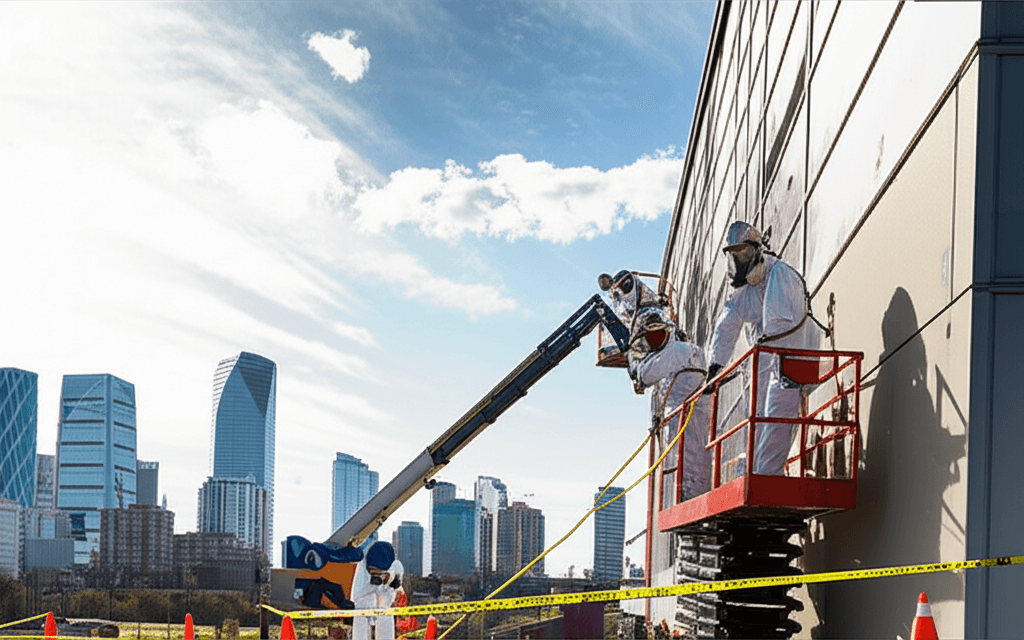
Puncture-resistant gloves over nitrile, cut-resistant sleeves, eye protection, and respiratory protection selected for the conditions. Coveralls and boot covers are changed between zones and bagged on exit.
Recovery method
Sharps are lifted with tongs, never by hand and never through a bag. Crews work a defined grid so ground is covered systematically, then re-sweep areas where bedding, tarps, or loose soil concealed the surface on the first pass.
Containment
Approved rigid containers travel with the crew and are filled to the marked line only. Containers are sealed on site and never decanted, sorted, or reopened afterwards.
Alberta's Occupational Health and Safety Code, Part 35, sets the requirements for controlling worker exposure to biological hazards, and Part 18 governs the selection and use of personal protective equipment. Our site-specific hazard assessments and exposure-response procedure are written to those parts and are available to clients who need them for their own contractor pre-qualification.
Waste streams and disposal chain
Everything leaving the site is separated at source. Mixing biomedical waste into general refuse is the failure that creates liability for a property owner long after the site looks clean, and it is avoidable with the right containers on the truck before the crew arrives.
Biomedical / sharps
Rigid approved containers, sealed on site, collected by a licensed biomedical waste carrier under manifest. Never enters the general waste stream.
Biohazard soft waste
Materials contaminated with human waste or bodily fluids are double-bagged, labelled, and routed to a facility permitted to receive them.
Household hazardous waste
Propane cylinders, fuel containers, batteries, aerosols, and solvents are segregated at source and taken to a City of Calgary hazardous waste drop-off or an equivalent regional facility.
Recoverable material
Metal, cardboard, and rigid plastics are separated where volume and site conditions make it practical.
General refuse
Remaining non-hazardous debris is hauled to an approved landfill with weigh tickets retained for the file.
Manifests and weigh tickets are collated into the project record rather than held loose, so the chain from site to receiving facility can be reconstructed if a question is raised months later.
When a site involves more than debris
Sites inside vacant buildings frequently raise a second question. Calgary's older industrial and commercial stock through Manchester, Ramsay, and the Foothills industrial area holds a great deal of pre-1990 material, and a building that has been open to the weather and to entry for months often has damaged insulation, disturbed ceiling material, or standing water alongside the debris.
Because we run abatement crews as well, that does not become a second procurement exercise. Where a site assessment identifies suspect material we scope it in the same visit and sequence the work so the hazardous material is dealt with in the right order rather than being disturbed by the cleanup itself.
- Damaged or disturbed suspect material is identified through asbestos testing before any debris is moved.
- Standing water and prolonged exposure often mean fungal growth, handled through mould abatement.
- Where structures or damaged interiors must come out, selective demolition is scoped alongside the cleanup.
Reducing repeat occurrence
Owners of vacant land and buildings frequently tell us the same site comes back within a season. We are not in a position to speak to why that happens — it sits well outside a remediation contractor's expertise — but we can report what we observed about the property itself, and that observation is part of every project record.
Our post-work notes cover unsecured access points, fencing condition, sightlines from adjacent roads, lighting, and the physical condition of any structures on site. Owners use these to brief their own security or facilities teams. We do not sell fencing, monitoring, or security services, so the observations carry no commercial interest on our part.
Frequently asked questions
Do you attend sites that are still occupied?
No. We attend after a site has been vacated. Decisions about notice, timing, and any interaction with people sheltering on a property rest with the property owner and the relevant public agencies. We schedule our crews around the date the owner confirms the site is clear.
How are needles and sharps handled?
Crews work with puncture-resistant gloves and sharps tongs, and every recovered item goes directly into an approved rigid sharps container rather than a general waste bag. Containers are sealed on site and consigned to a licensed biomedical waste carrier with a manifest that forms part of your project record.
What happens to personal belongings found on site?
Items that appear to be personal property — identification, documents, medication, photographs, phones — are set aside rather than discarded, logged, and handed to the property owner to deal with under their own retention obligations. We do not make disposal decisions about personal property on an owner's behalf.
How quickly can a crew attend?
For scheduled work across Calgary, Airdrie, Cochrane, Okotoks, Chestermere, and Canmore we typically mobilise within one to three business days of a confirmed scope. Sites with an active safety hazard — exposed sharps in a public right-of-way, structural damage, or a fire risk — are prioritised.
What documentation do we receive?
A pre-work site assessment with photographs, the completed scope of work, waste manifests for each stream including biomedical, a post-work photographic record, and any recommendations for securing the site. Municipal and institutional clients generally need all of these for their own compliance files.
Serving Calgary and southern Alberta
Book a site assessment
Send us the location and access details and we will attend, document the hazards, and return a scoped quote covering sharps, biohazard remediation, disposal, and records.
24/7 emergency response across Calgary and surrounding communities.