Asbestos abatement is the safe, regulated removal and disposal of asbestos-containing materials (ACM) from residential, commercial, and industrial properties.
In Calgary, where thousands of homes and buildings constructed before 1990 contain asbestos in ceilings, insulation, floor tiles, and mechanical systems, professional abatement protects occupant health, ensures legal compliance, and preserves property value.
This comprehensive guide explains Calgary's asbestos regulations, what to expect from professional abatement services, cost considerations, and how to choose qualified contractors for your project.
Understanding asbestos abatement in Calgary
Asbestos abatement encompasses several methods for managing asbestos-containing materials:
- •Removal: Complete extraction and disposal (most common and permanent solution)
- •Encapsulation: Sealing materials with specialized coatings to prevent fiber release
- •Enclosure: Building permanent barriers around materials to contain fibers
In Calgary renovation and demolition projects, complete removal is typically required because encapsulation and enclosure only delay the problem. Future renovations or structural changes will eventually require removal anyway, making it more cost-effective to address asbestos permanently when discovered.
When asbestos abatement is necessary
Professional asbestos abatement becomes necessary when:
- •Planning renovation or demolition in Calgary buildings constructed before 1990
- •Laboratory testing confirms presence of asbestos-containing materials
- •Asbestos materials are damaged, deteriorating, or will be disturbed by construction
- •Selling a property and buyers require documentation of asbestos removal
- •City of Calgary building codes require abatement before issuing permits
- •Emergency situations like fire, flood, or structural damage have exposed asbestos
Calgary asbestos regulations and compliance
Calgary property owners must navigate multiple regulatory layers when planning asbestos abatement. Understanding these requirements prevents costly delays, legal penalties, and failed inspections.
City of Calgary requirements
The City of Calgary Building Services department requires specific documentation for asbestos abatement:
- •Asbestos Management Form: Required for projects exceeding 1 square meter of friable material or 10 square meters of non-friable material
- •Permit application: Must include hazardous materials survey and detailed abatement plan
- •Site signage: Warning signs and occupant notification mandated during active abatement
- •Final clearance: Documentation required before renovation permit closure
This regulatory trigger means most Calgary renovation projects eventually require professional abatement services and proper permitting.
Alberta OH&S Code Part 4 compliance
Alberta's Occupational Health and Safety Code Part 4 governs asbestos handling across the province:
- •Type 1, 2, or 3 procedures: Based on material friability and project scope
- •Negative-pressure containment: Minimum 4 air changes per hour required
- •Personal air monitoring: Workers require exposure tracking and documentation
- •Medical surveillance: Programs required for all abatement workers
- •Written assessments: Hazard assessments and safe work procedures mandatory
Disposal and transport regulations
Calgary asbestos waste disposal follows strict protocols:
- •Transport to Shepard Landfill asbestos disposal cell only (the sole approved facility in Calgary)
- •Advance booking required by calling 403-268-2282
- •Waste must be double-bagged, sealed, and labeled per Transport Canada TDG regulations
- •Chain-of-custody manifests and disposal receipts mandatory for compliance
Professional contractors handle all regulatory compliance, permitting, and disposal scheduling—ensuring your Calgary project meets every requirement without delays or penalties.
The professional asbestos abatement process
Every Calgary asbestos abatement project follows a systematic five-stage process designed to eliminate exposure risk while meeting all regulatory requirements.
Stage 1: Initial inspection and testing
Certified inspectors visit your Calgary property to identify suspected asbestos-containing materials. Bulk samples are collected from ceilings, floor tiles, insulation, drywall compound, and mechanical systems. Samples are sent to accredited Calgary laboratories for analysis using polarized light microscopy (PLM), with results typically available within 24-48 hours.
Detailed reports identify material types, asbestos concentration levels, risk classifications, and removal cost estimates. These reports form the foundation for permit applications and abatement planning.
Stage 2: Permit filing and containment design
Once asbestos is confirmed, contractors file the City of Calgary Asbestos Management Form with Building Services and submit Alberta OH&S notifications. The team designs Type 1, 2, or 3 containment zones based on material friability and project scope.
Containment installation includes:
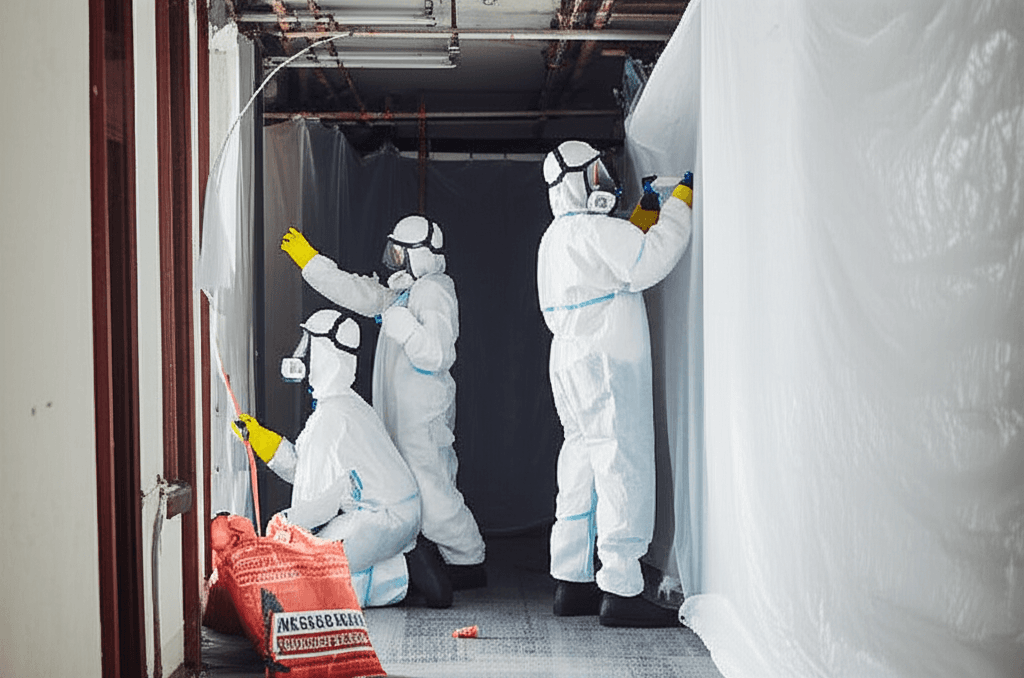
- •6-mil polyethylene sheeting creating airtight barriers
- •Negative-air machines with HEPA filtration preventing fiber migration
- •Three-stage decontamination chambers for worker entry/exit
- •HVAC isolation to prevent contamination spread
- •Required signage and access control measures
Stage 3: Safe removal and disposal
Licensed abatement technicians wearing full protective equipment remove asbestos materials using wet methods and HEPA-filtered vacuums to control dust and fiber release. All waste is immediately double-bagged in 6-mil polyethylene bags, sealed with duct tape, and labeled with asbestos warning stickers.
Real-time air monitoring ensures containment effectiveness throughout the removal process. Waste is transported directly to Shepard Landfill with complete chain-of-custody documentation and certified waste manifests.
Stage 4: Air quality testing and clearance
After removal is complete, independent third-party hygienists conduct clearance testing using aggressive air sampling with phase-contrast microscopy (PCM) or transmission electron microscopy (TEM). Testing verifies airborne fiber levels are below Alberta occupancy standards (less than 0.01 fibers per cubic centimeter).
Visual surface inspections confirm no remaining debris. Written clearance certificates state the area is safe for re-occupancy. Only after receiving clearance do contractors dismantle containment and release the site.
Stage 5: Final documentation and support
Complete project documentation includes:
- •Laboratory test reports and material analysis
- •Waste manifests and disposal receipts
- •Air clearance certificates from independent hygienists
- •Photographic evidence of completed work
- •Permit closure confirmation from City of Calgary Building Services
This documentation package satisfies insurance requirements, real estate disclosures, and future renovation planning. Property owners should keep these documents permanently with property files.
Asbestos abatement costs in Calgary
Calgary asbestos abatement costs typically range from $1,500 to $10,000+ for residential projects, depending on several factors:
Typical pricing ranges
- •Small projects ($1,500-$3,500): Single-room floor tile removal or limited popcorn ceiling work
- •Medium projects ($3,500-$6,000): Multi-room ceiling removal or basement pipe insulation
- •Large projects ($6,000-$12,000+): Whole-home vermiculite insulation removal or extensive multi-zone abatement
- •Commercial projects: Quoted individually based on scope, material type, and site complexity
Factors affecting abatement costs
- •Material type: Friable materials require more extensive containment than non-friable materials
- •Square footage: Larger areas increase labor time, disposal volume, and testing requirements
- •Containment complexity: Type 3 (high-risk) containment costs more due to negative-air systems and decontamination chambers
- •Site accessibility: Confined spaces, multi-story buildings, or complex logistics add complexity
- •Testing and clearance: Third-party air quality testing adds $500-$1,500 to project costs
- •Permitting fees: Municipal and provincial fees typically range from $100-$400
Professional contractors offer free on-site estimates with detailed, itemized pricing. Beware of contractors offering significantly lower prices than competitors—they're likely cutting safety corners or lacking proper insurance.
Timeline expectations for Calgary projects
Complete asbestos abatement timelines vary based on project size and material type, but typical Calgary residential projects follow this schedule:
- •Initial inspection and testing: 1 day for sampling, 1-3 days for laboratory results
- •Permit filing: 3-5 business days for City of Calgary approval
- •Containment setup: 2-4 hours for most residential projects
- •Material removal: 1-3 days depending on material extent and location
- •Clearance testing: 1 day for sampling, 1-2 days for laboratory analysis
- •Total timeline: 7-14 days from initial inspection to final clearance
Small projects like single-room floor tile removal can be completed in 2-3 days total. Large projects like whole-home vermiculite insulation removal may require 2-3 weeks. Emergency projects can be fast-tracked with rush permitting and testing, often completing within 3-5 days.
Choosing certified Calgary asbestos contractors
Selecting qualified asbestos abatement contractors protects your health, ensures legal compliance, and prevents costly mistakes. Here's what to verify:
Required certifications and licensing
In Alberta, legitimate asbestos abatement contractors must have:
- •CSA Z94.4 certification: Canadian standard for asbestos abatement training (all supervisors and technicians)
- •Alberta OH&S compliance: Current documentation showing Part 4 hazardous materials compliance
- •General liability insurance: Minimum $2 million, ideally $5 million or higher
- •WCB coverage: Workers' Compensation Board coverage for all employees
- •Transport Canada TDG: Transportation of Dangerous Goods certification for waste hauling
- •Medical surveillance: Respiratory monitoring programs for all workers
Warning signs to avoid
Be wary of contractors who:
- •Cannot provide certification proof or insurance documentation
- •Offer significantly lower pricing than competitors (likely cutting safety corners)
- •Suggest you don't need permits or testing
- •Recommend DIY removal to "save money"
- •Cannot provide references from recent Calgary projects
- •Use pressure tactics or create artificial urgency
- •Refuse to provide written estimates or formal contracts
Questions to ask potential contractors
- •How long have you been performing asbestos abatement in Calgary?
- •Can you provide proof of CSA Z94.4 certification and insurance?
- •Do you handle all City of Calgary permitting and OH&S notifications?
- •What is your clearance test success rate?
- •Can you provide recent Calgary client references?
- •Do you use independent third-party hygienists for clearance testing?
- •What is included in your quoted price?
Common Calgary asbestos materials
Calgary's diverse building stock spans heritage homes, 1970s bungalows, and modern high-rises. If your property was built before 1990, you may encounter these asbestos-containing materials:
Residential materials
- •Vermiculite attic insulation: Common in post-war Calgary homes, often containing asbestos from Libby, Montana mines
- •Vinyl asbestos floor tiles: 9×9 and 12×12 tiles with black mastic adhesive
- •Popcorn ceiling texture: Sprayed acoustic coatings popular in Calgary homes from 1950s-1980s
- •Drywall joint compound: Textured plaster and finishing compounds
- •Pipe and boiler insulation: White or grey wrap around basement heating systems
- •Cement board siding: Exterior cladding and roofing materials
Commercial and industrial materials
- •Sprayed fireproofing on structural steel in Calgary towers
- •Acoustic ceiling tiles and suspended grid systems
- •HVAC duct insulation and flexible connectors
- •Roofing felt and tar paper underlayment
- •Gaskets and packing materials in mechanical systems
Case study: Calgary condo tower abatement
A 1970s-era residential tower in Calgary's Beltline required emergency asbestos abatement after renovations exposed extensive sprayed fireproofing and pipe insulation containing 40% chrysotile asbestos. The strata council needed rapid mobilization to prevent work stoppages and minimize disruption to 60+ occupied units.
Challenge
Tight elevator access, shared ventilation systems, and Calgary's Asbestos Management Form requirements added complexity. The project required coordination with multiple trades, tenant communication, and strict adherence to City of Calgary permitting.
Solution
Professional abatement contractors mobilized within 12 hours, establishing six separate Type 3 containment zones using negative-air enclosures and HEPA scrubbers. Twenty-four-hour shifts completed abatement during off-peak hours, minimizing tenant disruption. All permits were filed with City of Calgary Building Services with daily communication to strata management and general contractors.
Results
- •48 hours from mobilization to final air clearance—ahead of schedule
- •Zero failed air samples—clearance achieved on first attempt across all six zones
- •No tenant complaints—containment prevented fiber migration to occupied units
- •Full documentation delivered within 24 hours for insurance and permitting
- •Renovation timeline maintained with immediate post-clearance work
Frequently asked questions
Can I stay in my Calgary home during asbestos abatement?
Occupancy during abatement depends on project scope and containment location. Small, isolated projects in basements or attics may allow occupancy in other areas. Multi-room or HVAC-connected projects typically require relocation for 1-3 days of active removal. Whole-home projects require complete relocation until clearance testing confirms safe re-occupancy.
Is asbestos abatement covered by Calgary insurance?
Coverage depends on your policy and circumstances. Sudden discovery during covered events (fire, flood, storm damage) is often partially covered. Asbestos removal discovered during planned renovations is typically not covered. Contact your insurance provider before starting work, and contractors can assist with required documentation.
What happens if clearance testing fails?
If clearance testing fails, the work area must be re-cleaned and re-tested—at the contractor's expense if the failure resulted from inadequate cleaning. Professional contractors with proper procedures rarely experience failed clearance tests. Reputable Calgary contractors often have zero failed clearances over multi-year periods.
Do I need asbestos abatement for renovations?
If your Calgary property was built before 1990 and renovations will disturb suspected asbestos materials, testing and potential abatement are legally required. City of Calgary building permits often require hazardous materials surveys before approval. Never disturb suspected materials until laboratory testing confirms composition.
Trust Calgary's certified abatement specialists
Conclusion: Protecting Calgary properties through professional abatement
Professional asbestos abatement in Calgary protects what matters most—your health, your family's wellbeing, and your property's future value. By understanding Calgary's regulatory requirements, choosing certified contractors, and following proper procedures from testing through clearance, you ensure safe, compliant removal that satisfies all legal requirements.
Don't risk DIY attempts or unlicensed contractors when certified professionals provide guaranteed results, complete permitting support, and peace of mind. The investment in proper abatement protects against health consequences, legal liability, and future property complications.
Ready to start your Calgary asbestos abatement project? Contact Makki Abatement for a free inspection and transparent pricing. Our certified technicians are available 24/7 for emergency response and routine project scheduling throughout Calgary and surrounding communities.
Additional resources:
Ready to start your asbestos removal project?
Request a free inspection or call 403-392-2803 to coordinate with Makki Abatement's certified team.