Professional asbestos removal is critical for protecting your health, your family, and your property value in Calgary.
When asbestos-containing materials are disturbed during renovation or demolition, microscopic fibers become airborne and can cause serious diseases including lung cancer, mesothelioma, and asbestosis. DIY removal or hiring unlicensed contractors puts everyone at risk—and violates Calgary building codes and Alberta OH&S regulations.
This comprehensive guide covers everything Calgary homeowners need to know about asbestos removal—from understanding costs and timelines to choosing certified contractors and ensuring legal compliance.
Why professional asbestos removal matters in Calgary
Calgary's building stock includes thousands of homes and commercial properties constructed before 1990, when asbestos was commonly used in construction materials. Professional asbestos removal provides critical protections that DIY attempts cannot match:
- •Health protection: Certified containment prevents fiber exposure for occupants, workers, and neighbors
- •Legal compliance: Proper permitting and disposal meet City of Calgary and Alberta OH&S requirements
- •Property value: Documented removal maintains marketability and prevents disclosure issues
- •Insurance coverage: Professional removal satisfies policy requirements and protects against liability
- •Guaranteed clearance: Third-party testing verifies safe fiber levels before re-occupancy
Common asbestos materials in Calgary homes
Calgary's diverse residential architecture—from heritage sandstone homes in Inglewood to 1970s bungalows across all quadrants—often contains these asbestos materials:
Most frequently removed materials
- •Vermiculite attic insulation: Common in Calgary post-war homes, often containing asbestos from Libby, Montana mines. Appears as small, lightweight pebbles in various colors.
- •Vinyl asbestos floor tiles (VAT): 9×9 and 12×12 tiles with black mastic adhesive, popular in Calgary basements and kitchens from 1950s-1980s.
- •Popcorn ceiling texture: Sprayed acoustic coatings found in countless Calgary homes, particularly those built between 1950-1985.
- •Drywall joint compound: Textured plaster and finishing compounds used extensively in older Calgary construction.
- •Pipe and boiler insulation: White or grey wrap around basement heating systems, especially in Calgary's older neighborhoods.
- •Cement board siding: Exterior cladding on Calgary homes, often mistaken for modern fiber cement.
Less common but still present
- •Window glazing and caulking compounds
- •Roofing felt and shingles
- •Stucco and exterior coatings
- •Gaskets around furnaces and wood stoves
- •Adhesives and mastics
Visual identification is unreliable—laboratory testing is the only way to confirm asbestos presence. Never disturb suspected materials until testing confirms their composition.
The professional asbestos removal process
Every Calgary asbestos removal project follows a systematic five-stage process designed to eliminate exposure risk while meeting all regulatory requirements.
Stage 1: Comprehensive inspection and testing
Certified Calgary inspectors visit your property to identify suspected asbestos-containing materials. Bulk samples are collected from ceilings, floor coverings, insulation, drywall compound, pipe wrap, and other suspect materials using specialized tools that minimize fiber release.
Samples are analyzed at accredited Calgary laboratories using polarized light microscopy (PLM) with results available in 24-48 hours for rush analysis or 3-5 business days for standard turnaround. Detailed reports identify material composition, asbestos type (chrysotile, amosite, crocidolite), concentration percentages, and removal cost estimates.
Stage 2: Engineered containment setup
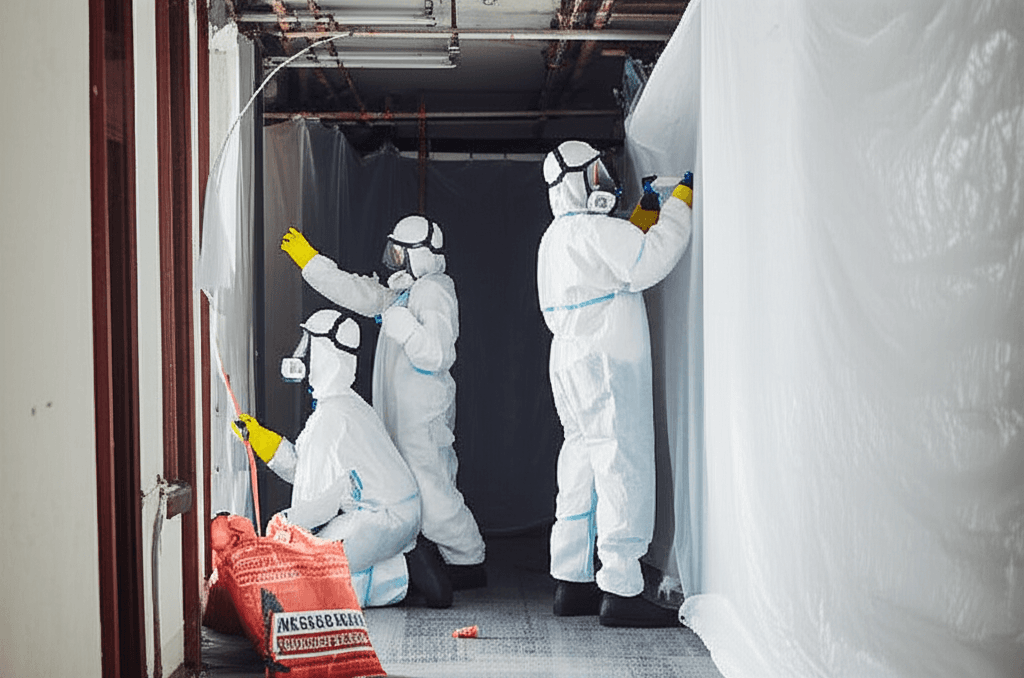
Before any removal begins, Calgary crews build certified containment zones using 6-mil polyethylene sheeting, airtight seals, and negative-air machines with HEPA filtration. Three-stage decontamination chambers are established for worker entry/exit, air monitoring equipment is installed, and required signage is posted.
For Calgary homes, contractors protect HVAC systems, seal doorways, and establish clean corridors to protect unaffected areas. All containment designs meet Alberta OH&S Type 1, 2, or 3 requirements based on material friability and project scope.
Stage 3: Safe material removal
Licensed technicians wearing full PPE (respirators with P100 filters, disposable Tyvek suits, gloves, boot covers) carefully remove asbestos materials using wet methods to suppress dust and fiber release. HEPA-filtered vacuums, hand tools, and specialized equipment designed for asbestos work minimize airborne contamination.
All removed materials are immediately double-bagged in 6-mil polyethylene bags, sealed with duct tape, labeled with asbestos warning stickers, and staged in secure areas. Real-time air monitoring ensures containment integrity throughout the Calgary removal process.
Stage 4: Proper disposal and transport
All asbestos waste is transported directly to the City of Calgary's Shepard Landfill asbestos disposal cell—the only approved facility in the region. Transport follows Transport Canada TDG (Transportation of Dangerous Goods) regulations with proper vehicle placarding and waste manifests.
Advance scheduling is required (Calgary residents must call 403-268-2282 to book disposal appointments). Contractors provide certified disposal receipts proving compliant waste handling—essential documentation for building permits, insurance claims, and future property transactions.
Stage 5: Third-party clearance testing
After removal is complete and containment surfaces are HEPA-vacuumed and wet-wiped, independent third-party hygienists conduct aggressive air clearance testing. Hygienists use fans and leaf blowers to agitate remaining dust while collecting air samples, which are analyzed using phase-contrast microscopy (PCM) or transmission electron microscopy (TEM).
Testing verifies airborne fiber levels are below Alberta occupancy standards (less than 0.01 fibers per cubic centimeter). Visual inspections confirm no remaining debris. Written clearance certificates state the area is safe for re-occupancy. Only after clearance do contractors dismantle containment and release the site for renovation or reconstruction.
Asbestos removal costs in Calgary
Calgary asbestos removal costs range from $1,500 to $10,000+ for residential projects, depending on material type, location, and square footage.
Typical project costs
- •Popcorn ceiling removal: $2,000-$3,500 for 200-300 square feet (single room)
- •Floor tile removal: $2,500-$5,000 for 500-1,000 square feet
- •Vermiculite attic insulation: $6,000-$12,000 for average Calgary homes (1,200-1,500 sq ft attic)
- •Pipe insulation removal: $1,500-$4,000 depending on extent and accessibility
- •Whole-home multi-material removal: $8,000-$15,000+ for comprehensive projects
What's included in professional pricing
Reputable Calgary contractors include these services in quoted prices:
- •Initial inspection and laboratory testing
- •Engineered containment with negative-air systems
- •Licensed technician labor and supervision
- •All materials (poly sheeting, bags, PPE, etc.)
- •Waste transport to Shepard Landfill
- •Disposal fees and manifests
- •Third-party air clearance testing
- •City of Calgary permit filing
- •Complete documentation package
Cost factors affecting pricing
- •Material friability: Friable (easily crumbled) materials require more extensive containment
- •Square footage: Larger areas increase labor time and disposal volume
- •Accessibility: Confined spaces like attics and crawl spaces add complexity
- •Building type: Multi-story homes or shared ventilation systems require additional precautions
- •Project urgency: Emergency mobilization may include premium pricing
Beware of contractors offering significantly lower prices than competitors—they're likely cutting safety corners, lacking proper insurance, or planning to add unexpected charges later. Transparent, mid-range pricing from certified contractors provides the best value and protection.
Timeline expectations for Calgary projects
Typical Calgary residential asbestos removal projects take 1-3 days from start to completion, including containment setup, material removal, and final air clearance testing.
Detailed timeline breakdown
- •Initial inspection: Same day or next day for most Calgary addresses
- •Laboratory results: 24-48 hours for rush analysis, 3-5 days standard
- •Permit processing: 3-5 business days through City of Calgary ePermit portal
- •Containment setup: 2-4 hours for typical residential projects
- •Material removal: 4-12 hours for small projects, 2-3 days for larger projects
- •Clearance testing: 1 day for sampling, 1-2 days for laboratory analysis
Project-specific timelines
- •Small single-room projects: 2-3 days total from inspection to clearance
- •Medium multi-room projects: 5-7 days from start to finish
- •Large whole-home projects: 2-3 weeks including all testing and clearance
- •Emergency fast-tracked projects: 3-5 days with rush permitting and testing
Choosing certified Calgary asbestos contractors
Selecting qualified asbestos removal contractors protects your health, ensures legal compliance, and prevents costly mistakes.
Essential certifications to verify
- •CSA Z94.4 certification: Canadian standard for asbestos abatement training (required for all supervisors and technicians)
- •Alberta OH&S Code Part 4 compliance: Current hazardous materials handling certification
- •General liability insurance: Minimum $2 million coverage, $5 million preferred
- •WCB coverage: Workers' Compensation Board protection for all employees
- •Transport Canada TDG: Transportation of Dangerous Goods certification
Questions to ask potential contractors
- •How long have you been performing asbestos removal in Calgary specifically?
- •Can you provide proof of CSA Z94.4 certification and insurance documents?
- •Do you handle all City of Calgary permitting, or will I need to file permits?
- •What is your clearance test success rate over the past 3 years?
- •Can you provide references from recent Calgary residential projects?
- •Do you use independent third-party hygienists for clearance testing?
- •What exactly is included in your quoted price?
- •What happens if clearance testing fails?
Red flags to avoid
- •Cannot provide certification proof or insurance documentation immediately
- •Pricing significantly lower than other Calgary contractors (30%+ below average)
- •Suggesting you skip laboratory testing or permits to "save money"
- •Recommending DIY removal for cost savings
- •Pressure tactics or artificial urgency to sign contracts
- •Unwilling to provide written estimates or formal contracts
- •No local Calgary references or established presence
- •Vague timelines or unclear scope of work
Service areas across Calgary and region
Professional asbestos removal services are available throughout Calgary and surrounding communities:
Calgary quadrants
- •Calgary NW: Kensington, Hillhurst, Sunnyside, Montgomery, Bowness, Tuscany, Arbour Lake, Brentwood, Dalhousie, Varsity
- •Calgary NE: Bridgeland, Renfrew, Winston Heights, Marlborough, Temple, Coral Springs, Saddle Ridge, Cityscape, Redstone, Skyview Ranch
- •Calgary SW: Mission, Cliff Bungalow, Bankview, Killarney, Glenbrook, Altadore, Britannia, Elbow Park, Garrison Woods, Springbank Hill
- •Calgary SE: Inglewood, Ramsay, Forest Lawn, Lynnwood, Ogden, Riverbend, McKenzie Towne, Mahogany, Auburn Bay, Legacy
Surrounding communities
Extended service to Airdrie, Cochrane, Okotoks, Chestermere, High River, Strathmore, Canmore, and Bragg Creek. Same-day response available within Calgary city limits, 24-48 hour mobilization for regional communities.
Safety protocols during Calgary removal
Professional asbestos removal uses multiple safety layers to prevent exposure:
Containment and isolation
- •Airtight polyethylene barriers isolate work areas from occupied spaces
- •Negative air pressure pulls air into containment using HEPA-filtered machines
- •HVAC systems sealed to prevent fiber migration through ductwork
- •Warning signs and physical barriers prevent unauthorized entry
Worker protection
- •Full-face respirators with P100 filters or supplied-air systems
- •Disposable Tyvek suits, gloves, and boot covers
- •Three-stage decontamination chambers for safe entry/exit
- •Personal air monitoring for exposure tracking
Occupant safety
Most Calgary contractors recommend occupants vacate during active removal (typically 1-3 days) as a precaution. Properly contained projects pose no risk to adjacent rooms, but temporary relocation provides additional peace of mind—especially for children, elderly family members, or those with respiratory conditions.
Calgary customer experiences
Kensington home renovation
"We discovered asbestos floor tiles during our Kensington home renovation. The contractor was at our door the next morning, had containment built by noon, and finished removal the same day. Their Calgary crew was professional, respectful, and incredibly efficient. The clearance test came back perfect, and our contractor was back to work within 48 hours."
— Michael and Sarah Chen, Kensington, Calgary NW
Calgary property management portfolio
"As a property manager overseeing 30+ Calgary rental properties, I've worked with the same contractor on multiple asbestos projects. Their pricing is always fair, communication is excellent, and they handle all City paperwork without me having to lift a finger. Most importantly, they've never failed an air test—which means no delays and happy tenants."
— Jennifer Patel, Multiple Calgary locations
Forest Lawn industrial emergency
"Emergency asbestos situation in our Forest Lawn warehouse—exposed pipe insulation during a plumbing repair. The team mobilized within 3 hours on a Saturday, built containment around our operations, and completed removal over the weekend so we didn't lose a single business day. Outstanding service."
— Tom Hendricks, Forest Lawn Industrial, Calgary SE
Frequently asked questions
Do I need a permit for asbestos removal in Calgary?
Yes, Calgary requires an Asbestos Management Form filed with City of Calgary Building Services for projects exceeding 1 square meter of friable asbestos or 10 square meters of non-friable asbestos. Alberta OH&S also mandates notifications for all Type 3 (high-risk) projects. Professional contractors handle all permitting and notifications as part of their service.
Can I remove asbestos myself in Calgary?
Alberta regulations technically allow property owners to remove small amounts of asbestos from their own homes, but it's strongly discouraged. DIY removal risks exposure to carcinogenic fibers, improper disposal, legal penalties, and future liability.
Most homeowner insurance policies void coverage for DIY asbestos work. Professional removal costs far less than potential health consequences and legal fees.
How do I know if my Calgary home has asbestos?
Homes and buildings in Calgary constructed before 1990 are highly likely to contain asbestos in materials like popcorn ceilings, floor tiles, insulation, drywall compound, pipe wrap, or siding.
Visual identification is unreliable—laboratory testing is the only way to confirm. Professional contractors offer free on-site inspections and collect samples for accredited laboratory analysis with results in 24-48 hours.
Is asbestos removal safe for my family and pets?
Yes—when performed by licensed professionals using proper containment. Negative-air enclosures and HEPA filtration prevent fiber migration beyond work zones. Contractors recommend occupants and pets vacate during active removal as a precaution, but neighboring rooms and units remain safe. Third-party air clearance testing confirms zero exposure before re-occupancy.
What documentation will I receive?
Complete documentation includes:
- •Laboratory test reports identifying asbestos content
- •Photographic documentation of materials and removal
- •Waste transport manifests and disposal receipts
- •Third-party air clearance certificates
- •City of Calgary permit closure confirmation
Keep these documents permanently with your property files for insurance purposes, future renovations, and property transactions.
Trust Calgary's certified removal specialists
Conclusion: Safe asbestos removal for Calgary homes
Professional asbestos removal in Calgary protects your health, ensures legal compliance, and preserves property value. By understanding costs, timelines, and safety protocols—and by choosing certified contractors with proven Calgary experience—you ensure safe, compliant removal that satisfies all regulatory requirements.
Don't risk DIY attempts or unlicensed contractors when certified professionals deliver guaranteed results, complete permitting support, and peace of mind. The investment in proper removal protects against health consequences, legal liability, and future property complications.
Ready to start your Calgary asbestos removal project? Contact Makki Abatement for a free inspection and transparent pricing. Our certified Calgary technicians are available 24/7 for emergency response and routine project scheduling throughout all Calgary neighborhoods and surrounding communities.
Additional resources:
Ready to start your asbestos removal project?
Request a free inspection or call 403-392-2803 to coordinate with Makki Abatement's certified team.