Asbestos removal is one of the most critical home improvement and renovation considerations for properties built before 1990.
This naturally occurring mineral fiber, once celebrated for its heat resistance and durability, is now recognized as a serious health hazard responsible for thousands of deaths annually from lung diseases and cancer. Understanding asbestos removal—from initial identification through final clearance—protects your health, ensures legal compliance, and preserves property value.
This comprehensive guide covers everything you need to know about asbestos removal, including what asbestos is, where it's found, health risks, the professional removal process, costs, regulations, and how to choose qualified contractors.
Whether you're a homeowner planning renovations, a property manager maintaining buildings, or simply concerned about potential asbestos exposure, this guide provides the knowledge you need to make informed decisions.
What is asbestos?
Asbestos refers to six naturally occurring silicate minerals composed of thin, fibrous crystals. Each fiber is composed of millions of microscopic fibrils that can be released into the air and inhaled. The most common types used in construction include:
- •Chrysotile (white asbestos): Accounts for approximately 95% of asbestos used in buildings. Found in roofing, insulation, ceiling tiles, and floor tiles.
- •Amosite (brown asbestos): Used primarily in cement sheets, pipe insulation, and thermal insulation products.
- •Crocidolite (blue asbestos): The most dangerous form, used in specialized insulation and cement products.
- •Tremolite, anthophyllite, and actinolite: Less common forms found as contaminants in talc, vermiculite, and other minerals.
Why asbestos was widely used
From the late 1800s through the 1980s, asbestos was considered a "miracle material" due to its remarkable properties:
- •Heat resistance: Withstands temperatures up to 1,000°F without degradation
- •Fire retardance: Naturally non-flammable and prevents fire spread
- •Chemical resistance: Resists acids, bases, and most chemical reactions
- •Durability: Extremely strong and resistant to degradation
- •Affordability: Abundant and inexpensive to mine and process
- •Versatility: Could be woven, mixed with other materials, or sprayed
These properties made asbestos ideal for insulation, fireproofing, soundproofing, and strengthening materials. It was used in over 3,000 different products, from construction materials to automotive parts to household items.
When asbestos use was banned
As health risks became undeniable, countries began restricting asbestos use:
- •Canada: Phased out through the 1970s-1980s, with most uses discontinued by 1990
- •United States: EPA began regulations in 1973, with significant restrictions by 1989
- •European Union: Complete ban implemented in 2005
- •Australia: Total ban on manufacture, use, import, and export since 2003
Despite these bans, millions of buildings constructed before 1990 still contain asbestos materials. The mineral remains legal in some countries, and asbestos-containing products continue to be manufactured globally, though in declining quantities.
Where asbestos is found in buildings
Asbestos was used so extensively in construction that virtually any building constructed before 1990 likely contains some asbestos-containing materials (ACM). Understanding where asbestos hides helps you identify potential hazards before renovations or demolition.
Common residential locations
- •Insulation: Vermiculite attic insulation (particularly Zonolite brand from Libby, Montana), pipe and boiler wrap, duct insulation, wall cavity fill
- •Ceilings: Popcorn texture, acoustic ceiling tiles, suspended ceiling panels, decorative plaster
- •Flooring: 9×9 and 12×12 vinyl asbestos tiles (VAT), sheet vinyl backing, underlayment, black mastic adhesive
- •Walls: Drywall joint compound, textured coatings, wallboard, cement board
- •Roofing: Asphalt shingles, cement shingles, roofing felt, flashing, caulking
- •Siding: Cement board siding, shingles, cladding panels
- •Other: Window glazing, stucco, plaster, fireplace insulation, heating equipment gaskets
Commercial and industrial locations
- •Sprayed fireproofing on structural steel beams and columns
- •HVAC duct insulation and flexible connectors
- •Boiler and furnace insulation
- •Elevator equipment panels and brake shoes
- •Gaskets, packing materials, and seals in mechanical systems
- •Electrical panel partitions and arc chutes
- •Laboratory fume hood panels and countertops
Friable vs. non-friable asbestos
Asbestos materials are classified by how easily they release fibers:
- •Friable asbestos: Materials that can be crumbled by hand pressure when dry, readily releasing fibers. Examples include sprayed insulation, damaged pipe wrap, and deteriorated ceiling texture. Friable asbestos poses the highest health risk and requires the most stringent removal procedures.
- •Non-friable asbestos: Materials where asbestos fibers are locked in a binding matrix (cement, vinyl, etc.) that prevents easy fiber release. Examples include intact floor tiles, cement siding, and roofing shingles. Non-friable materials become friable when damaged, sanded, sawed, or demolished.
The distinction matters because regulations, removal procedures, and costs differ significantly between friable and non-friable materials.
Health risks of asbestos exposure
Asbestos is classified as a Group 1 carcinogen by the International Agency for Research on Cancer (IARC), meaning there is sufficient evidence that it causes cancer in humans. When asbestos materials are disturbed, microscopic fibers become airborne and can be inhaled deep into the lungs, where they lodge permanently in lung tissue.
Asbestos-related diseases
Exposure to asbestos fibers can cause several serious, often fatal diseases:
- •Asbestosis: Progressive scarring of lung tissue (pulmonary fibrosis) causing shortness of breath, chronic cough, chest tightness, and reduced lung capacity. No cure exists, and severe cases require oxygen therapy or lung transplantation. Typically develops 10-40 years after initial exposure.
- •Mesothelioma: Aggressive cancer affecting the lining of the lungs (pleural mesothelioma), abdomen (peritoneal mesothelioma), or heart (pericardial mesothelioma). Almost exclusively caused by asbestos exposure. Median survival is 12-21 months after diagnosis. Latency period is typically 20-50 years.
- •Lung cancer: Asbestos exposure significantly increases lung cancer risk, with risk multiplying dramatically for smokers (synergistic effect). Symptoms include persistent cough, chest pain, breathing difficulty, and bloody sputum. Develops 10-30 years after exposure.
- •Pleural diseases: Thickening, scarring, and calcification of the lung lining causing breathing difficulties, chest pain, and reduced lung function. Can occur with relatively low exposure levels.
- •Other cancers: Emerging evidence links asbestos to laryngeal, ovarian, colorectal, and stomach cancers.
Who is at risk?
While occupational exposure historically posed the greatest risk, anyone can be exposed to asbestos:
- •Homeowners and DIY renovators: Disturbing asbestos during home improvement projects without proper protection
- •Family members: Secondary exposure from fibers brought home on workers' clothing and equipment
- •Building occupants: Long-term low-level exposure from deteriorating materials in homes, schools, and offices
- •Construction workers: Renovation and demolition workers encountering asbestos in older buildings
- •Emergency responders: Firefighters and rescue workers exposed during building fires and disasters
Exposure levels and risk
There is no safe level of asbestos exposure. While higher cumulative exposure increases disease risk, even brief exposure can cause disease decades later. Key facts about exposure risk:
- •Single fiber inhalation can initiate disease processes
- •Risk increases with exposure duration and fiber concentration
- •Latency periods of 10-50 years mean diseases often appear long after exposure
- •Smoking combined with asbestos exposure multiplies lung cancer risk by 50-90 times
- •No medical treatment can remove asbestos fibers once inhaled
For detailed information about asbestos health risks, see our guide on what asbestos is and how dangerous it is.
The professional asbestos removal process
Professional asbestos removal follows a systematic process designed to eliminate exposure risk while meeting regulatory requirements. Understanding each stage helps you evaluate contractors and know what to expect.
Stage 1: Inspection and testing
Every professional removal project begins with comprehensive testing:
- •Visual inspection: Certified inspectors examine all suspected asbestos-containing materials based on age, appearance, and location
- •Sample collection: Bulk samples are collected from each suspect material using specialized tools that minimize fiber release
- •Laboratory analysis: Accredited laboratories analyze samples using polarized light microscopy (PLM) or transmission electron microscopy (TEM)
- •Reporting: Detailed reports identify material types, asbestos content percentages, risk classifications, and removal recommendations
Testing typically takes 1-3 days for results, with rush analysis available for urgent projects. Never disturb suspected materials until laboratory testing confirms their composition—visual identification is unreliable.
Stage 2: Planning and permitting
Once asbestos is confirmed, certified contractors prepare documentation and design containment:
- •Permit applications: Filing required municipal permits (City of Calgary Asbestos Management Form, etc.)
- •Regulatory notifications: Submitting provincial occupational health and safety notifications
- •Containment design: Engineering Type 1, 2, or 3 containment based on material friability and project scope
- •Work plans: Developing detailed procedures, timelines, and safety protocols
- •Disposal scheduling: Booking approved landfill appointments and transport arrangements
Permit approval typically takes 3-5 business days, though emergency projects can be expedited.
Stage 3: Containment setup
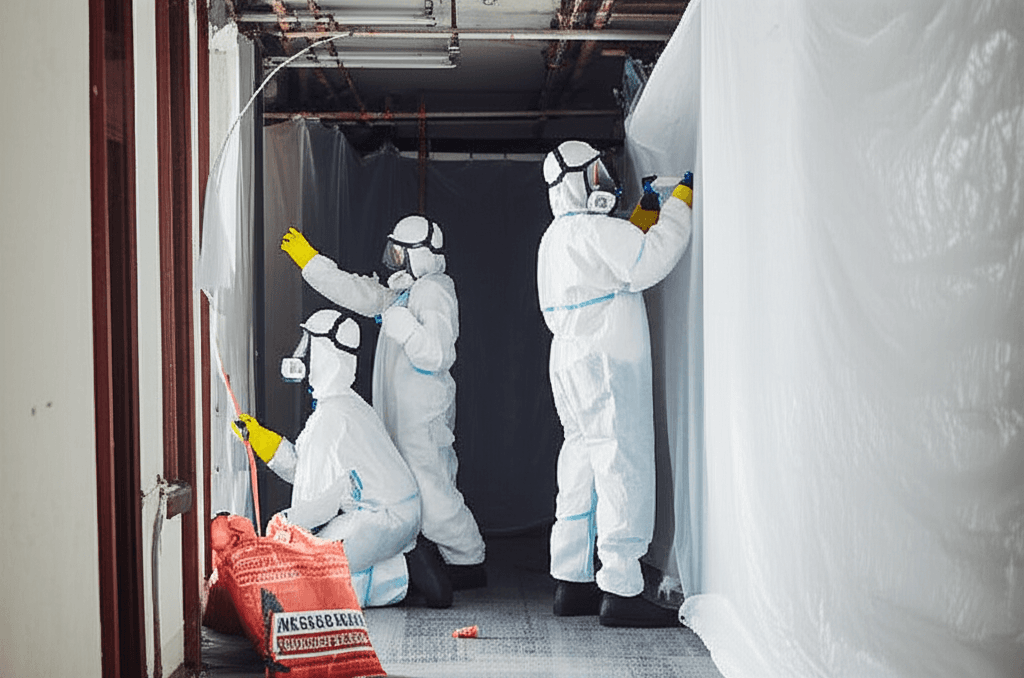
Before any material is disturbed, crews build engineered containment zones:
- •Barrier installation: 6-mil polyethylene sheeting seals floors, walls, and ceilings creating airtight work zones
- •Negative-air systems: HEPA-filtered fans create negative pressure, pulling air into containment and preventing fiber escape
- •Decontamination chambers: Three-stage areas (dirty room, shower, clean room) for workers to remove protective equipment
- •HVAC isolation: Ventilation systems are sealed to prevent fiber migration through ductwork
- •Access control: Warning signs, physical barriers, and entry protocols prevent unauthorized access
Containment setup typically takes 2-4 hours for residential projects, longer for complex commercial installations.
Stage 4: Material removal
Licensed technicians wearing full protective equipment remove asbestos materials:
- •Respiratory protection: Full-face respirators with P100 filters or supplied-air systems
- •Protective clothing: Disposable Tyvek suits, gloves, and boot covers preventing fiber contact
- •Wet methods: Materials are saturated with amended water or surfactants to suppress dust and fiber release
- •Hand tools: Manual removal using scrapers, pry bars, and cutting tools designed for asbestos work
- •HEPA vacuuming: High-efficiency vacuums capture fibers during removal and cleanup
- •Double-bagging: All waste is placed in 6-mil polyethylene bags, sealed, labeled, and placed in second bags
- •Air monitoring: Real-time fiber measurements verify containment effectiveness
Removal duration depends on material type, quantity, and accessibility—ranging from several hours to several days.
Stage 5: Disposal and transport
Asbestos waste disposal is strictly regulated:
- •Approved facilities: Waste must be transported to designated asbestos disposal cells (Shepard Landfill in Calgary, etc.)
- •Transport compliance: Following Transportation of Dangerous Goods (TDG) regulations with proper placarding
- •Chain of custody: Waste manifests track material from site to final disposal
- •Disposal receipts: Certified documentation confirming proper handling and disposal
Professional contractors handle all transport and disposal, providing documentation for your permanent property records.
Stage 6: Clearance testing
After removal and cleaning, independent third-party hygienists conduct clearance testing:
- •Visual inspection: Examining all surfaces for visible debris, dust, or residual materials
- •HEPA vacuuming: All surfaces vacuumed using HEPA-filtered equipment
- •Wet wiping: Surfaces wiped with damp cloths to capture remaining fibers
- •Aggressive air sampling: Using fans and leaf blowers to agitate dust while collecting air samples
- •Laboratory analysis: Air samples analyzed using phase-contrast microscopy (PCM) or transmission electron microscopy (TEM)
- •Clearance determination: Fiber levels must be below regulatory standards (typically Small projects ($1,500-$3,500): Single-room popcorn ceiling removal, limited floor tile removal, small pipe insulation projects
- •Medium projects ($3,500-$6,000): Multi-room ceiling removal, basement pipe insulation, moderate floor tile areas
- •Large projects ($6,000-$12,000+): Whole-home vermiculite insulation removal, extensive multi-zone abatement, complete siding replacement
- •Commercial projects: $5,000-$50,000+ depending on building size, material extent, and operational constraints
Cost factors
Multiple variables affect final pricing:
- •Material friability: Friable materials require more extensive containment (Type 3 vs. Type 1), increasing costs by 50-100%
- •Square footage: Larger areas increase labor time, disposal volume, and testing requirements
- •Accessibility: Confined spaces (attics, crawl spaces), multi-story heights, and site access challenges add 20-40% to base costs
- •Containment complexity: Type 3 containment with negative-air systems costs significantly more than Type 1 barrier methods
- •Testing requirements: Pre-removal sampling and post-removal clearance testing add $500-$1,500 per project
- •Permitting fees: Municipal and provincial fees range from $100-$400 depending on jurisdiction
- •Disposal costs: Landfill fees based on waste volume, typically $200-$800 for residential projects
- •Project urgency: Emergency mobilization may include 20-50% premium pricing
What's included in professional quotes
Reputable contractors include these services in quoted prices:
- •Initial inspection and laboratory testing
- •Engineered containment with negative-air systems (if required)
- •Licensed technician labor and supervision
- •All materials (poly sheeting, bags, PPE, wetting agents, etc.)
- •Waste transport to approved disposal facilities
- •Disposal fees and chain-of-custody manifests
- •Third-party air clearance testing
- •Permit filing and regulatory notifications
- •Complete documentation package
Cost-saving considerations
While professional removal isn't cheap, several factors can reduce costs:
- •Timing flexibility: Scheduling during contractors' slower periods may yield better rates
- •Project bundling: Combining multiple areas in single mobilization reduces per-area costs
- •Material access: Clearing work areas and ensuring easy site access reduces labor time
- •Competitive bidding: Obtaining 3-5 quotes helps identify fair market pricing
Beware of contractors offering prices significantly below market rates (30%+ lower than competitors)—they're likely cutting safety corners, lacking proper insurance, or planning unexpected charges.
Asbestos regulations and legal requirements
Asbestos removal is heavily regulated at federal, provincial/state, and municipal levels. Understanding applicable regulations ensures legal compliance and protects against penalties.
Canadian regulations
- •Federal level: Health Canada provides guidelines; Transport Canada regulates asbestos transport via TDG regulations
- •Provincial level: Each province sets occupational health and safety requirements (Alberta OH&S Code Part 4, Ontario Regulation 278/05, etc.)
- •Municipal level: Cities require permits and notifications (Calgary Asbestos Management Form, Toronto permit requirements, etc.)
United States regulations
- •EPA regulations: National Emission Standards for Hazardous Air Pollutants (NESHAP) govern demolition and renovation
- •OSHA standards: 29 CFR 1926.1101 sets workplace exposure limits and work practice requirements
- •State regulations: Many states have additional requirements beyond federal standards
- •Local regulations: Counties and cities may require additional permits and notifications
Key regulatory requirements
Regardless of jurisdiction, most regulations require:
- •Pre-demolition/renovation surveys: Asbestos testing before disturbing materials in pre-1990 buildings
- •Licensed contractors: Certified technicians and supervisors for removal projects
- •Work notifications: Advance notice to regulatory authorities before starting work
- •Proper containment: Engineered barriers and negative-air systems for friable materials
- •Approved disposal: Transport to designated asbestos disposal facilities only
- •Clearance testing: Independent verification of safe fiber levels before re-occupancy
- •Documentation: Maintaining records of testing, removal, and disposal for specified periods
Penalties for non-compliance
Violating asbestos regulations can result in:
- •Fines ranging from $1,000 to $1,000,000+ depending on jurisdiction and severity
- •Stop-work orders halting construction projects
- •Criminal charges for willful violations causing exposure
- •Liability for health damages to exposed individuals
- •Property liens and forced remediation at owner expense
- •Disclosure requirements affecting property sales
DIY vs. professional asbestos removal
Some homeowners consider DIY asbestos removal to save money. While some jurisdictions technically permit property owners to remove small amounts from their own homes, the reality is that DIY asbestos work is dangerous, often illegal, and ultimately more expensive when considering health risks and compliance failures.
Legal considerations for DIY removal
Even where technically permitted, DIY removal faces significant legal constraints:
- •Commercial properties: Occupational health and safety codes mandate certified abatement for all workplace asbestos removal
- •Rental properties: Landlords must hire licensed contractors to protect tenant health
- •Permitted projects: Many municipalities require certified contractors for any permitted abatement work
- •Disposal restrictions: Most landfills only accept asbestos from licensed contractors with proper documentation
- •Insurance voidance: DIY removal typically violates homeowner insurance policies, denying coverage for contamination or exposure claims
Why professional removal is safer
Certified contractors provide safety measures impossible to replicate in DIY projects:
- •Engineered containment: Negative-air enclosures with HEPA filtration prevent fiber migration beyond work zones
- •Proper respiratory protection: Full-face respirators with P100 filters or supplied-air systems (not hardware store dust masks)
- •Wet removal methods: Specialized equipment and wetting agents suppress fiber release during removal
- •Decontamination procedures: Three-stage wash stations prevent workers from carrying fibers outside containment
- •Real-time monitoring: Air sampling verifies containment effectiveness throughout the project
- •Independent clearance: Third-party hygienists confirm safe fiber levels before re-occupancy
- •Liability insurance: $2-5 million coverage protects against exposure claims and property damage
True cost comparison
DIY removal may seem cheaper initially, but true costs include:
- •Equipment: Negative-air machines ($500-$1,000 rental), HEPA vacuums ($300-$800), poly sheeting, tape, bags ($200-$400)
- •Protective gear: Tyvek suits, respirators, filters, gloves, goggles for all workers ($200-$500)
- •Disposal: Landfill fees, often higher for non-commercial haulers ($150-$400)
- •Testing: Pre-removal sampling and post-removal clearance testing ($500-$1,500)
- •Lost time: Learning procedures, slower work pace (3-5x longer than professionals)
- •Re-work costs: Failed clearance testing requires complete re-cleaning or professional intervention
- •Health consequences: Medical monitoring, treatment costs if exposure occurs
Most importantly, DIY removal risks serious health consequences that no amount of money can fix. Professional removal typically costs $1,500-$10,000 for residential projects—a fraction of potential medical expenses and legal liabilities.
Choosing certified asbestos removal contractors
Selecting qualified contractors is critical for ensuring safe removal, legal compliance, and preventing costly mistakes.
Essential certifications and credentials
Verify contractors possess these minimum qualifications:
- •Asbestos abatement certification: CSA Z94.4 (Canada), EPA-approved training (US), or equivalent jurisdiction-specific credentials
- •Occupational health compliance: Current documentation showing compliance with provincial/state hazardous materials regulations
- •General liability insurance: Minimum $2 million coverage, $5 million preferred
- •Workers' compensation: Full coverage for all employees
- •Transportation certification: TDG (Canada) or DOT (US) certification for hazardous waste transport
- •Medical surveillance: Respiratory monitoring programs for all workers
Questions to ask potential contractors
- •How long have you been performing asbestos removal in this area?
- •Can you provide proof of certification and insurance immediately?
- •Do you handle all permit filing and regulatory notifications?
- •What is your clearance test success rate over the past 3 years?
- •Can you provide recent client references for similar projects?
- •Do you use independent third-party hygienists for clearance testing?
- •What exactly is included in your quoted price?
- •What happens if clearance testing fails?
- •How do you protect occupied areas during removal?
- •What documentation will I receive upon completion?
Red flags to avoid
Reject contractors who:
- •Cannot provide certification proof or insurance documentation immediately
- •Offer pricing 30%+ below competitors (likely cutting safety corners)
- •Suggest skipping laboratory testing or permits to "save money"
- •Recommend DIY removal for cost savings
- •Use pressure tactics or create artificial urgency
- •Refuse to provide written estimates or formal contracts
- •Cannot provide local references or established business presence
- •Offer vague timelines or unclear scope of work
- •Suggest occupants don't need to vacate during removal
- •Don't include third-party clearance testing in quotes
Getting and comparing quotes
Obtain 3-5 detailed written estimates including:
- •Itemized breakdown of all costs (labor, materials, disposal, testing, permits)
- •Specific materials to be removed with square footage
- •Containment type and specifications
- •Timeline from start to clearance
- •Payment schedule and terms
- •Warranty or guarantee information
- •Proof of insurance and certifications
Don't automatically choose the lowest bid—evaluate based on credentials, transparency, communication, and overall value.
Local asbestos removal resources
Finding qualified asbestos removal services in your area:
- •Calgary asbestos removal: Professional services throughout Calgary and surrounding communities. See our comprehensive guide to asbestos removal in Calgary.
- •Find services near you: Locate certified contractors in your region with our guide on finding asbestos removal near you.
- •Emergency services: Many contractors offer 24/7 emergency response for urgent situations like fire damage, flood exposure, or accidental disturbance.
Related hazardous materials considerations
Properties with asbestos often contain other hazardous materials requiring professional remediation:
- •Mould contamination: Water damage frequently accompanies asbestos projects. Learn the differences in our guide on mould vs. asbestos.
- •Lead paint: Common in pre-1978 buildings, often found alongside asbestos
- •PCBs: Polychlorinated biphenyls in electrical equipment and caulking
- •Mercury: Found in thermostats, switches, and fluorescent fixtures
For comprehensive hazardous materials management, see our demolition and hazardous materials safety checklist.
Frequently asked questions about asbestos removal
How do I know if my home contains asbestos?
Buildings constructed before 1990 are likely to contain asbestos in various materials. Visual identification is unreliable—laboratory testing is the only definitive method. Professional inspectors collect bulk samples for accredited laboratory analysis, with results typically available within 24-48 hours.
Is asbestos dangerous if left undisturbed?
Intact asbestos materials in good condition pose minimal risk when left undisturbed. However, asbestos becomes hazardous when materials deteriorate, are damaged, or are disturbed during renovation or demolition. Even materials in good condition should be tested and documented for future reference.
Can I remove asbestos myself?
While some jurisdictions technically permit homeowners to remove small amounts from their own properties, DIY asbestos removal is extremely dangerous and strongly discouraged. Professional removal costs far less than potential health consequences, legal penalties, and property contamination cleanup.
How long does asbestos removal take?
Small residential projects can be completed in 1-3 days from containment setup to clearance. Larger projects may require 1-2 weeks. Complete timelines from initial testing through final documentation typically span 7-14 days for straightforward residential projects, longer for complex commercial work.
What should I do if I accidentally disturbed asbestos?
If you suspect you've disturbed asbestos: (1) Stop work immediately, (2) Leave the area and close doors, (3) Do not use fans or air conditioning, (4) Change clothes and shower if fibers may have contacted you, (5) Contact a professional asbestos contractor for assessment and cleanup. Do not attempt to clean up yourself.
Will insurance cover asbestos removal?
Insurance coverage depends on your policy and circumstances. Sudden discovery during covered events (fire, flood, storm damage) may be partially covered. Asbestos removal discovered during planned renovations is typically not covered. Contact your insurance provider before starting work, and contractors can assist with required documentation.
How much does asbestos removal cost?
Residential asbestos removal typically costs $1,500-$10,000+ depending on material type, quantity, and project complexity. Small single-room projects start around $1,500-$3,500, while whole-home removal can exceed $10,000. Commercial projects range from $5,000 to $50,000+ based on building size and scope.
Can I stay in my home during asbestos removal?
Occupancy depends on project scope and containment location. Small, isolated projects may allow occupancy in unaffected areas. Multi-room or HVAC-connected projects typically require relocation for 1-3 days during active removal. Whole-home projects require complete relocation until clearance testing confirms safe re-occupancy.
Conclusion: Protecting health through professional asbestos removal
Asbestos removal is not a DIY project—it's a critical health and safety measure that requires professional expertise, specialized equipment, and strict regulatory compliance.
Whether you're planning renovations, managing properties, or responding to asbestos discovery, partnering with certified contractors ensures safe removal that protects your health, satisfies legal requirements, and preserves property value.
Understanding asbestos—from identification and health risks through the complete removal process—empowers you to make informed decisions. While professional removal represents a significant investment, the cost is minimal compared to potential health consequences, legal liabilities, and property complications from improper handling.
The key takeaways from this guide:
- •Asbestos is a serious health hazard found in millions of buildings constructed before 1990
- •Laboratory testing is the only reliable way to confirm asbestos presence
- •Professional removal follows a systematic process ensuring safety and compliance
- •Costs typically range from $1,500-$10,000+ for residential projects
- •Regulations require certified contractors, proper containment, and clearance testing
- •DIY removal is dangerous, often illegal, and more expensive long-term
- •Choosing qualified contractors protects against health risks and legal penalties
If you're facing an asbestos removal project, start by obtaining professional testing and multiple quotes from certified contractors. Verify credentials, ask detailed questions, and select contractors based on expertise and transparency rather than lowest price alone.
Ready to start your asbestos removal project? Contact certified professionals for free inspections and detailed estimates. For location-specific information, see our guides on asbestos removal in Calgary or finding asbestos removal near you.
Additional resources:
Ready to start your asbestos removal project?
Request a free inspection or call 403-392-2803 to coordinate with Makki Abatement's certified team.